



This story is about what happens when management mistakes automation for talent, and how one workplace experiment accidentally proved why human creativity still matters.
“AI is going to replace you.”
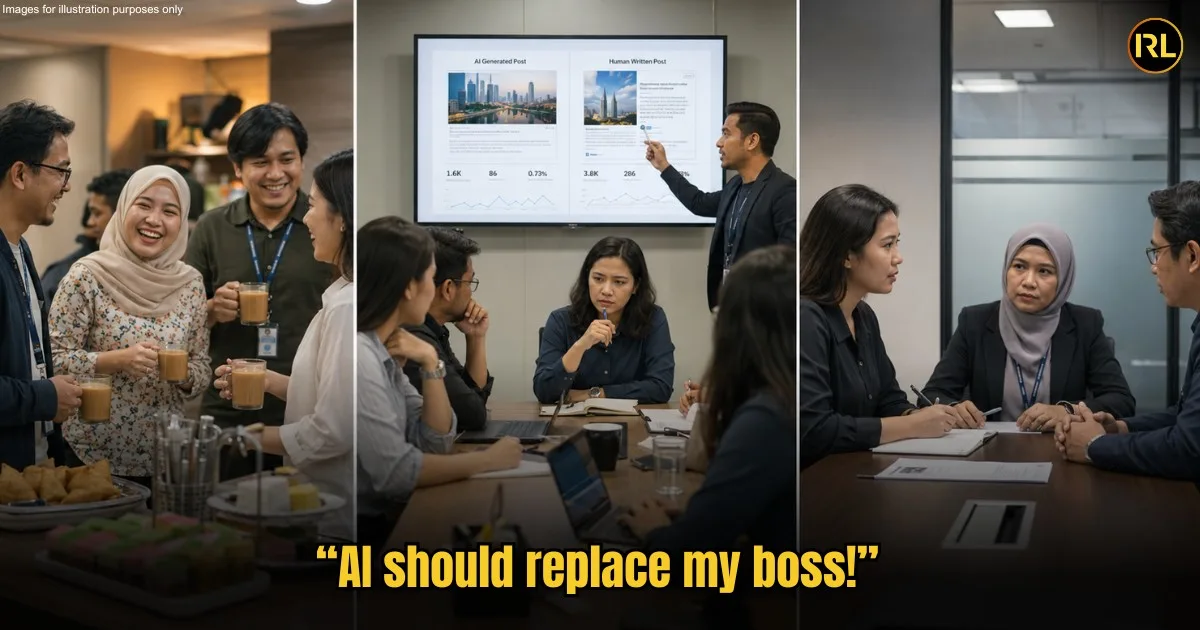
It was Friday, just after the last recap meeting of the week. Everyone drifted into the pantry, grabbing a teh tarik, pulling out kuih or karipap, and having a chat and some banter as usual to pass the time before going home. My direct manager, “Bazil” said, “At this rate, AI is going to replace you as our copywriter.” Everyone laughed. Even though I did fire back, “Please lah! I already write better than AI.”
Someone jumped in with “we should A/B test it.” There was more laughter, and someone commented sarcastically that the “winner should get promoted.” This was all teasing and good humor on a Friday afternoon at the end of the work week.
Who am I?
I bit back a sarcastic retort of my own about recognition, an increment or a bonus. I’m in marketing and sales, but someone let slip that I used to be an English teacher. Suddenly I was correcting language and grammar. Within months, campaign content needed my “approval” because “you’re the only one who understands the brand voice.”
It was a “temporary” duty that became quietly permanent, and then expanded into doing the actual writing. There was no title change, no promotion, or pay increase. Just increased responsibility and full accountability for underperforming content.
A manager obsessed with AI
The problem is a management obsession with using AI to generate content. Meetings became obsessed with “automating content creation so we can scale efficiently.” Bazil pushed for AI subscriptions for everything: Writing, video, audio, chatbots. We even had AI usage KPIs. He was trend chasing, citing cost-cutting and time savings as justifications.
My colleagues were using AI tools, without proper training and quality dropped as Bazil rubber-stamped approval on everything the AI wrote. I didn’t have the time to edit or rewrite emotionally dead and generically interchangeable captions that lacked personality or energy.
Bazil was converting creatives into what I call “Sloperators.”
The Sloperators
My colleagues fall into two groups: “Sloperators” who dump prompts into ChatGPT or MidJourney, then submit mass-produced low-effort slop content as “good enough.” Then the few who use AI to enhance their creativity.
I use AI tools for surface-level research. At work, graphic designers like that my written brief has visual mock ups and concept references. Videography is so much easier because I can mock up storyboards quickly, and produce references for sets and shoot locations. I include sample sound effects and music clips where appropriate to speed production. I believe that AI tools are powerful and when used correctly, increase efficiency without replacing human creativity or judgement.
The Challenge
The following week, during a content planning meeting, Bazil brought it up again, laughing as he suggested testing it for real as a “fun internal experiment,” using low risk scheduled posts that would not affect major campaigns. Everything would be the same except that ChatGPT would write one and I would write the other.
He was convinced the AI would win easily. I didn’t hesitate and stepped up. Maybe it was the way I spoke, or the way I’d cracked the plastic pen in my grip. My coworkers stopped laughing. They realized I was taking this seriously because I have more than a decade of writing experience as a freelance content writer and self-published novelist.
The Tests
Over three weeks, the “test” was done on LinkedIn, Facebook and Instagram with the same audience targeting, timing, and topics. AI beat me on speed and polish. But it failed to consistently replicate local tones or styles. It strung together keywords and influencer-speak sounding safely generic. It produced content you scrolled past after the first sentence.
I told work stories on LinkedIn that people could relate to, leading to higher interactions. One coworker joked that “AI has never worked a real job.” On Facebook, I left an even wider gap, and you could see the mood shift as everyone realized the “AI tak faham Malaysian mindset.” I do. From reactions and clickthroughs to conversions, I beat the AI on every metric that mattered.
The Instagram post I wrote was built around a small relatable moment in life. It was shorter, messier, and human. The AI’s sanitized, trend-aware, algorithm friendly post lost because it failed to connect with a Malaysian audience.
The Results
I leaned back in my chair and just let the numbers on the screen speak for me. Publicly embarrassed, Bazil’s face tightened and he verbally lashed out, saying I was taking things way too personally, being “emotional.” He defended the testing as “just for fun,” and went so far as to dismiss my work as something “kampung budak” can handle. The office was quiet. When he was done, I went back to my desk and started writing something else.
HR gets Involved
My email to HR didn’t focus on his testing stunts. I focused on the public humiliation and disrespect, how he had tried and failed to undermine my competence as a writer doing needed work for the company’s social media platforms. I cited my colleagues in the meeting as witnesses.
I also pointed out that I was not hired as a copywriter and would no longer do writing or editing because he had publicly berated me after I had been doing a good job for at least the past six months. I demanded immediate action, stating that otherwise “my next publication will be to my lawyer with sufficient documentation to make a strong case for constructive dismissal and workplace harassment.”
HR reacted with surprising speed, calling a tense “conflict resolution” meeting within the week. Bazil glared at me the entire time while I pointedly ignored him and took detailed handwritten notes, asking only one question: Why had Bazil not hired a copy/content writer after a year of vacancy?
The follow up from HR came two weeks later with an apology, and acknowledgement of my contributions. They offered a formalized hybrid role that came with a salary increment, adjusted job description and title to include content writing work. This included a “role adjustment bonus” which was a pleasant surprise. Bazil was formally reprimanded, reassigned and transferred to another department. I accepted, and bcc’ed everything to my personal email.
The office atmosphere changed after that. The jokes about AI replacing people stopped completely. One graphic designer quietly thanked me for slowing down the company’s ‘AI-only’ approach. Every piece of content now needed human review before going live, no matter who or what wrote it. I didn’t mind. It was officially part of my job now.
AI is a tool to augment, not create
AI can remix and imitate convincingly, but its output still depends entirely on human input, direction and judgement. For now, AI alone struggles to consistently produce content that resonates with a target audience. That is something human judgement and context provides, and I hope that it’s a balance we can maintain.
Replacing my manager with an AI would be more feasible than replacing me: he mostly assigns tasks and decides responsibility without much explanation or context.
Submit your story to ym.efillaerni@olleh and you may be featured on In Real Life Malaysia.
Read also: ‘I gave up my family to pursue my dreams’ Shares 34 YO M’sian woman – In Real Life
‘I gave up my family to pursue my dreams’ Shares 34 YO M’sian woman
More from Artificial Intelligence

Cloud Country: What Malaysia’s Data Centre Boom Costs on the Ground
In February 2026, Malaysia saw its first public protest against a data centre. Residents of Gelang Patah, Johor, gathered outside …
“Teacher Blindly Trusted AI Plagiarism Tool and Failed My Son!” shares Outraged M’sian Mother
This is a user-submitted story. Names and details have been omitted to protect individual privacy.