





Ramli spoke to us in Malay. This story has been translated and lightly edited for clarity.
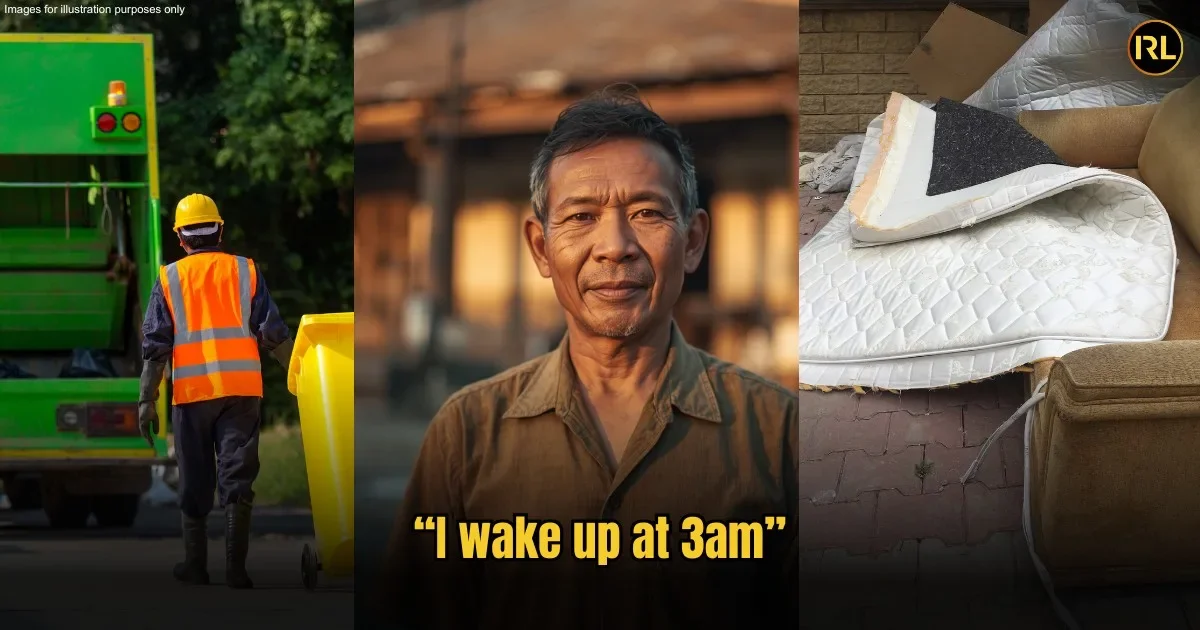
Ramli (name changed to protect his privacy) wakes up at 3am every morning because that is when the city of Kuala Lumpur needs him, and in 22 years, he has never once made it wait.
By 3.30am, he is already on the truck, making his way through streets that most KL residents will only ever see lit up and busy. At this hour, the streets are quiet. This is the version of the city that belongs to him. He knows this city better than most people who live in it. He just doesn’t get credited for it.
From Pahang to KL
Ramli is 51 years old, originally from a small Orang Asli settlement in Pahang. He came to KL at 29, following a cousin who had found work in the city and said there was more of it available. He had a wife, a young child, and not much else beyond the willingness to do whatever was needed.
He found work with a waste management company contracted to handle residential and commercial collection across several zones in the city. He expected to stay a year or two, save enough money, and go back home.
That was 22 years ago.
His children, now grown, have since left for other parts of the country. His eldest daughter works as a nurse in Seremban. His son is doing odd jobs in Johor. They call on weekends.
“I always thought KL was short-term,” he says, in careful, measured Malay. “But I get comfortable. My job is stable. Pay comes every month. And after 20 years my kids have grown up here and this place is just home.”
What He Sees
Ask Ramli what surprises him most after 22 years and he does not hesitate.
“What people throw away.”
He has seen things in the rubbish that made him stop and look twice. Furniture that was barely used. Clothing with the tags still on. A baby crib, assembled and intact, left at the curb of a condominium in Mont Kiara. Electronics still in their boxes. Once, in the bin of a bungalow in Damansara Heights, a full set of cookware, pots and pans all matching, that looked like it had never touched a stove.
“The big condo areas, the bungalow areas, those ones got the most to throw,” he says, not with bitterness but with the flatness of someone stating a fact they have verified many thousands of times.
“The things they throw away, other people would be grateful to have.”
Over the years, he has quietly set things aside before they reached the truck. A plastic tricycle for a neighbour’s child. A standing fan that just needed a new blade. A shelf he still uses in his rented room in Kepong.
He does this carefully, within what the job allows. He is not taking what is not his. The city has already decided these things have no value.
What It Is Like To Be Invisible
This is the part of the conversation where Ramli goes quiet for a moment before he answers.
“People don’t look at you,” he says finally. “They walk past you like you are part of the road.”
He does not say this like it wounds him, exactly. More like something he made his peace with a long time ago, even if the peace was hard-won.
In 22 years, he can count on one hand the number of residents who have ever greeted him by name, or greeted him at all. Most people, he says, close their gates a little faster when the truck comes. Some residents in higher-end areas have complained about the noise at odd hours, as though the solution might be to simply not collect the rubbish rather than to tolerate the inconvenience.
A resident once came out to shout at him for leaving a small smear of refuse on the curb. He apologised and cleaned it up. She went back inside without another word.
“It’s okay,” he says. “They don’t really care lah. Everyone’s busy. Just if one day we don’t come, then they’ll notice. But as long as we come, it’s okay, they won’t think about it. Normal.”
He is correct that they don’t. Most people encounter the result of his work, the clean street, the empty bin, without ever connecting it to the person who made it so.
Being Orang Asli in KL
Ramli grew up speaking his community’s language, then Malay, then enough Cantonese to get by in certain parts of KL where it was useful on the job. He has always been able to move between worlds. He has also always known he doesn’t belong completely to any of them.
“In my kampung, I’m the city man now,” he says, with something close to a smile. “When I balik kampung, they say wah, you dah jadi orang KL already. But here also, people still know I’m from kampung. Cannot hide one.”
He says this without self-pity. But he says it clearly, the way a person says something they want heard.
He has watched the city change around him across two decades. The towers that went up in areas he used to collect from when they were low-rise. The neighbourhoods that were torn down and replaced with something shinier. He has collected the rubbish of the construction workers who built those towers, and then the rubbish of the people who moved into them.
“KL is always changing,” he says.
What Keeps Him Going
His shift ends around noon, sometimes later if the zone is large or the volume is high. He goes home, sleeps a few hours, eats whatever is easy, and gets up early the next morning to do it again.
He is not unhappy. That is the thing that is important to say clearly, because it would be easy to read this story as a sorrowful one, and he does not experience his life that way.
He has a community of fellow workers he considers brothers. A small surau near his place where he goes for Jumaat prayers and runs into familiar faces. A phone full of photos of his grandchild, born eight months ago to his daughter in Seremban.
He plans to retire in three or four years and go back to Pahang. His wife wants to be near the grandchild. He wants to sleep past 3am.
“I worked many years in this city,” he says, standing up to leave, pulling on a jacket against the morning chill that the rest of KL has not yet woken up to feel. “22 years. I think can rest already.”
He means it practically. He has done his time, paid his dues, earned his rest.
But it lands like something else too. Like a man quietly noting, after 22 years of waking before the city opens its eyes, that the city never once thought to say thank you.
Submit your story to ym.efillaerni@olleh and you may be featured on In Real Life Malaysia.
Read also: ‘I gave up my family to pursue my dreams’ Shares 34 YO M’sian woman – In Real Life
‘I gave up my family to pursue my dreams’ Shares 34 YO M’sian woman
More from Real People
“Goodbye Malaysia, I Wish You Well” Former M’sian Who Gave Up Citizenship Says It Was Not About Money
He was the kind of Malaysian who stood at attention when the national anthem played on morning television. His family …
A New Vintage: Richie on Art, Family and Coming Back
This story is about a Malaysian artist finding his way back to art, family and community and discovering that coming …

“The Bank Just Told Me To Come Home” M’sian Man’s Lost IC Used To Steal Electricity Across Six Factories
Kuang, 35, has never applied for a housing loan, a car loan or a credit card, has never been to …