






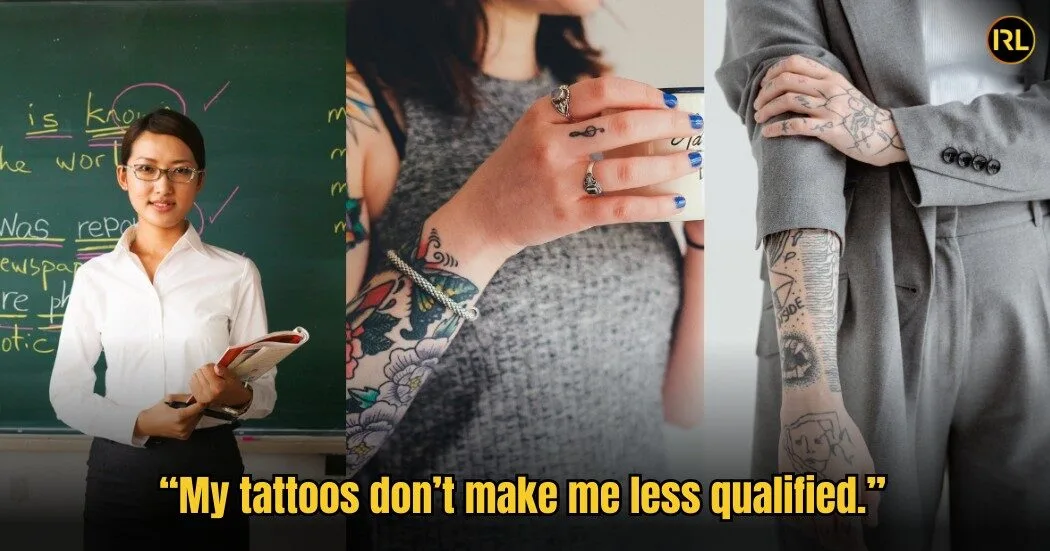
This opinion piece is shared by a teacher who challenges the idea that tattoos should be covered up and calls for greater acceptance of tattoos in Malaysia’s private education sector.
In a society that prides itself on individual freedom and personal expression, why do tattoos and piercings still face such harsh judgment, particularly in the professional world?
In the professional world, especially in schools, the pressure to conform is immense. It’s not just about dressing a certain way or wearing makeup—it’s about making yourself invisible in the name of professionalism.
As a teacher with visible tattoos and piercings, I have personally experienced the tension between my desire to express myself authentically and the pressure to conform to outdated standards of professionalism.
Tattoos and Piercings: A Source of Identity or Judgment?
As I was applying for my teaching job, I was specifically told that to be considered a “good fit,” I would need to remove all visible piercings and cover my tattoos. It felt like a denial of who I am as a person. I was being asked to erase part of my identity to fit into a narrow mold of what was deemed acceptable.
“Shouldn’t my ability to teach, my experience, and my passion for helping students be enough? Why does my appearance matter so much?” I remember asking myself.
It’s a common dilemma faced by people with tattoos or piercings, particularly in fields that prioritize a specific image, such as education. Yet, the question remains: Why do we continue to force individuals to sacrifice their identity for the sake of fitting into an antiquated professional standard?
The Stereotypes Behind the Ink
The stereotype that tattoos and piercings make someone unprofessional is rooted in age-old biases that continue to dominate the workplace. Historically, tattoos were associated with sailors, criminals, or people living on the fringes of society.
While society has evolved significantly since then, the negative perceptions still linger. Tattoos, particularly visible ones, continue to be viewed by some as symbols of defiance, rebellion, youthfulness, instability, or lack of professionalism.
Despite the increasing normalization of body art in mainstream culture, it’s clear that there’s still a divide between how tattoos are perceived in the workplace.
It’s interesting to consider that even though we live in a world that has come a long way in terms of diversity and inclusion, the idea of professionalism is still often tied to appearance rather than ability or character. As one study on workplace bias shows, employees with tattoos are often assumed to be less competent, regardless of their actual skill or qualifications.
For people like me, this often means covering up tattoos with long sleeves or hiding piercings behind subtle jewelry, even when these things have no bearing on the quality of my work. The very fact that I’m a teacher with tattoos and piercings often makes others question my ability, which is unfair.
It’s About Ability, Not Appearance
The crux of the issue lies in the outdated definition of professionalism itself. Professionalism should not be determined by someone’s appearance but by their skills, work ethic, and ability to perform in their role.
In recent years, we’ve seen significant shifts in how we define success and professionalism, with a growing emphasis on diversity and inclusion.
More companies, schools, and organizations are embracing individuality and welcoming diverse expressions of identity. It’s not uncommon for industries like tech, art, and even marketing to celebrate tattoos and piercings as signs of creativity and self-expression.
In fact, many people—particularly the younger generations—are pushing back against these outdated stereotypes and rejecting the idea that body art has anything to do with a person’s work ethic or capability.
However, the traditional mindset still holds strong in some sectors, including education. Many of us are left to navigate this divide, balancing our desire for self-expression with the need to conform to professional expectations.
The idea that I can’t be a good teacher just because of my tattoos is an outdated perspective that needs to change. It’s frustrating when you’re asked to hide something that’s so integral to your identity, especially when you know that your qualifications and teaching ability should be the focus, not the ink on your skin. I hope that the next generation of educators and professionals won’t have to go through the same struggles.
By breaking down these stereotypes, we can create a more inclusive and accepting environment for all kinds of professionals—whether they choose to wear tattoos, piercings, or none at all.
A Call for Change
The battle to be seen as professional despite tattoos and piercings is not one that can be fought alone. It requires a collective shift in how we view professionalism in the workplace.
We need to question the assumptions we make based on appearance and acknowledge that someone’s work performance, skills, and character are far more important than how they choose to express themselves through body art.
We should also be mindful that the push to remove tattoos and piercings is often rooted in classism and racism. Historically, tattoos and piercings have been more common among marginalized communities.
As such, insisting on the removal of body art in professional settings can disproportionately affect people of color, working-class individuals, and those who have long used tattoos as a form of resistance or self-expression.
As we continue to advocate for diversity and inclusion, it’s essential to recognize the value of body art as an extension of personal identity, rather than a marker of unprofessionalism.
For those of us caught in the tension between our personal identity and societal expectations, it’s time to challenge the status quo. Let’s work together to create spaces where professionalism is defined by who we are, not just how we look. Only then can we truly embrace diversity in all its forms and move beyond the limitations of outdated stereotypes.
Have a story to share?
Submit your story to ym.efillaerni@olleh and you may be featured on In Real Life Malaysia.
Read also:
More from Opinion

This Syrian Woman Compares Living in Malaysia with Her Home Country
This story is by a Syrian woman who shares her experiences of two parts of Asia that don't often get …

“I’m not a Man!” Woman Who Is Constantly Mistaken For a Man in M’sia Shares Her Daily Struggle
This story is a user submission about one woman’s experience of being called a man in an MRT restroom, shining …

“Puasa Kan Kena Hormat?” What’s The Etiquette in M’sia for Eating in Public During Ramadan?
In this opinion piece, In Real Life contributor Nazmie shares his personal reflections on Ramadan in Malaysia. Every year, as Ramadan …