



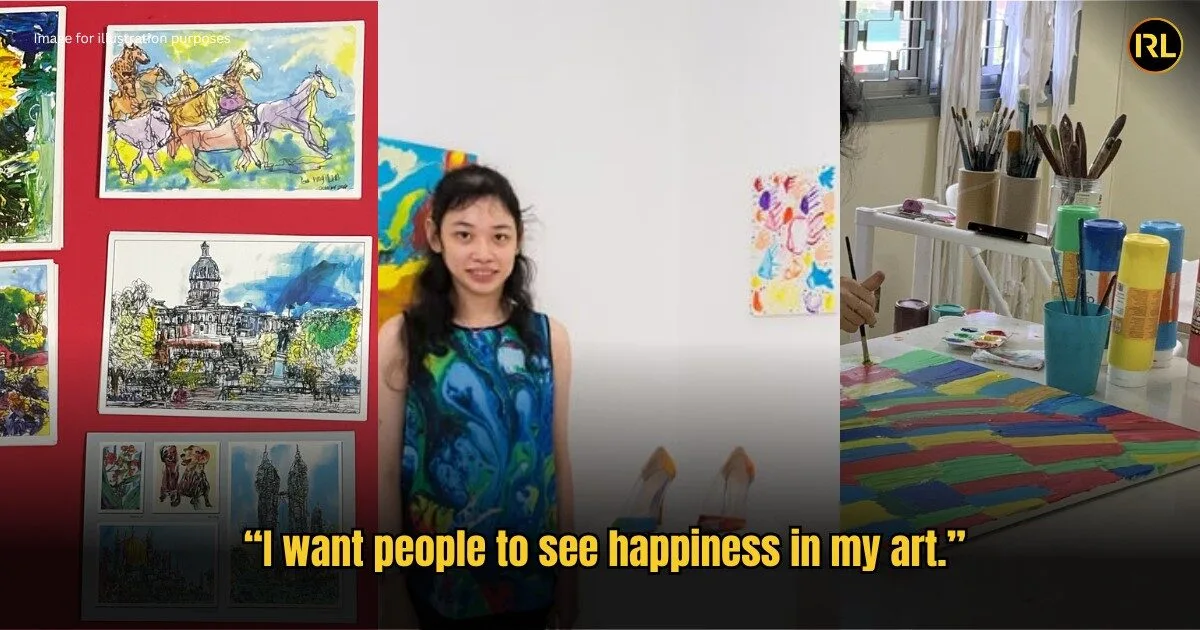
This interview is about Janet Lee, a Malaysian artist with epilepsy and learning challenges, whose vibrant art and legacy inspire neurodivergent voices to thrive.
An interview about artist Janet Lee
When you speak with Joyce Moi, there’s a stillness that comes when love outlives loss. Her voice carries the same warmth, quiet conviction and grace that walked beside her daughter. Janet Lee’s story is one of courage and color. Through seizures, learning challenges, art and growing a space for neurodivergent voices in Malaysia.
In the wake of the documentary “Perfectly Imperfect The Janet Lee Story,” Malaysians have come to know the artist, and legacy in the Janet Lee Gallery which works to support and empower neurodivergent individuals to live, create, and be accepted on their own terms.
Our conversation was about more than remembrance, but life behind the colours and canvas, the lessons of love and resilience, and the legacy that continues to grow after Janet’s final brushstroke.
Janet’s Early Life and Discovery of Art
- How did you first discover Janet’s artistic side, and what drew her to painting?
Janet started colouring and painting at a very young age, almost the moment she could hold a pencil and brush.
- What were the early challenges she faced growing up with epilepsy and developmental delays?
She was not diagnosed as intellectually disabled till she was 16 years old. The real challenges she and us as parents faced were her sudden epileptic attacks that gave no sign, aura or warning.
With an attack every two to three days, our anxiety was constantly high; after each episode, we would have a brief 24-hour respite before the tension returned, building again in anticipation as we stayed on alert for the next attack.
- How did art become part of her therapy or communication?
Janet always played with colors, choosing those she liked instead of following the norm, so her art was never appreciated. I still remember clearly this colouring book that showed a yellow banana. Most kids would follow and color. Janet coloured it purple because “This is my banana and I want it this colour”.
- When you look back, was there a moment you realised art was more than a hobby? That it was her voice?
(insert image of Artwork Reflection)
When I observed how she painted “Reflection” in 2017, I realised that her colours were not just colours. They carried a meaning or represented something that she had in her mind. This was like 7 years after she started her art journey when we gave her the freedom to explore and paint whatever and however she liked.
- What kind of environment helped her grow as an artist despite her condition?
We created an environment where Janet felt safe, accepted, and free of expectations, pressure, and judgment to express herself. Instead of focusing on limitations, we focused on what brought her joy.
We gave her the space to freely explore what she should paint and encouraged her to try different art materials to satisfy her curiosity and to find her likes and dislikes. Over time, that freedom helped her gain confidence – not just as someone painting but as an artist with her own voice.
Her Art and Creative Identity
- How would you describe Janet’s style and approach to her work?
Janet was a colourist – instinctively drawn to vibrant, expressive colours. We can safely say that her style was “freestyle” as she didn’t follow conventional rules or planned compositions. She painted from emotion and feeling in the moment.
- Did her emotions or seizures influence the way she painted?
It did! Most of Janet’s paintings depict happy moments except when she painted immediately before or after an attack. Those paintings then tend to be a bit gloomy and darker in tone.
- What message or feeling did Janet want people to take away from her art?
Janet never said it aloud, but I believe she wants people to see “joy” or “happiness” in her art. This happens to be the general feedback from her collectors as well.
- How did she react when her work began to gain international attention?
She tried to stay cool but I could feel the joy and pride within her as she would ask questions like “What did sister or daddy say about my art?” or “Why do they (the collectors or viewers) like my art?” She would ask these questions shyly and when she stood next to a painting with her collector, her smile said it all: Happy.
- What was Janet like in her studio? Was she disciplined, spontaneous, or completely in the moment?
Once she starts painting, she is into her own world – no conversations, no pauses in between. She would just paint till she felt she had had enough or when we prompted her to stop.
Due to her medication, we try to get her to stop after about 2 hours of continuous painting as we noticed that fatigue would set in, making her movements shaky.
Overcoming Barriers and Building a Life
- As her mother, what were some of the hardest moments supporting Janet through her health and learning challenges?
There were numerous throughout her life. When she was young (from baby to pre-school years) it was more about her safety since she could have an attack anytime.
When she started pre-school and in the years thereafter, finding a school who would accept her because of her medical condition was a challenge. When we finally did, her inability to follow what was thought in class was worrying. She started sleeping in class and kids noticed that she was different so she didn’t have any friends but she was quick to find out that giving candies can bring forth friendship and this is when she would spend money daily just to buy candies to spend with her friends. The joy of having people surrounding her made her happy.
As she grew older, the health issues became more worrying. While Janet wanted to live a normal life, many normal activities could put her at risk. Swimming was dangerous, especially if she suffered an attack in the water. She loved roller coaster rides but the excitement could trigger an attack.
Travelling was also a challenge: Flight timings would disrupt her sleep, and increase her stress. Stop-overs were a challenge as she would have to speed up her walking, increasing her heart rate and the risk of a seizure. .
Her learning disabilities were the greatest challenge. No one could help until I met an educational specialist when she was 16. Janet learned to read and write at 16. It was difficult for everyone to believe that she would be able to pick up reading and writing at that age. But she did.
- How did you help her find confidence and independence when society often underestimated her?
I gave her space to try – and to fail – without shame. I didn’t push her to meet society’s timelines, but encouraged her to follow her own pace, celebrate her small wins, and to pursue her own interests.
I made sure she felt seen and heard, even when the world around us didn’t understand her. For example, when she was able to read a kindergarten book at 16 years old, it was an achievement that we celebrated.
I focused on what she could do, and looked for opportunities to share her work with others. Breaking the “I am nobody” was really tough as she was only seeing recognition coming from people who were from family members or our friends. The real joy wasn’t there. The redefining moment was the selection of her art for the Hidden Truths Project Art Exhibition in the US back in 2014.
Travelling abroad, meeting strangers from another part of the world and seeing her artwork sell, really helped her see that her work is really being appreciated and she is “somebody”.
- What kept both of you motivated during the most difficult years?
Janet’s positive attitude. Janet was a rolling stone. When she achieved something she wanted more. When we started our first venture in 2015, I put some of her works in a small space at my friend’s florist shop. We would do stock rotation on a weekly basis.
Thinking that she was happy with the arrangement, I suggested to her about opening up little corners in different places using the same concept. Her answer was “No. One place where people can see everything that I do is enough.” Many years later, Janet Lee Gallery materialised this dream.
When she could finally read and write at age 16, her next question was “When can I graduate like my sister?” This led me to search for an educational programme that would be meaningful to her. She achieved this dream in 2017, earning a Diploma in Small Business Management. She even asked that she travel to Pennsylvania for her convocation instead of just having the robe sent over and photos taken with family members.
I am continuing her business, and her work because of her parting words:
“I love you. I will never leave you. I will always be with you. We are a family.”
- Did you face misunderstanding or stigma when explaining Janet’s condition to others?
Yes. In her younger days, it was stressful whenever she had an attack in public as people would ask questions like “Did you eat something wrong during pregnancy?” “Have you tried this?” and “You mustn’t let her eat that”. They meant well, but none of it helped us when we were trying to get Janet out of an attack.
When she grew older and would only speak to selected people ignoring others completely, people mistook her behaviour as autistic. Some found her conversation childish and would distance themselves from her.
Very often all these actions would make me feel like the best place to be is “home” but I knew that this would be doing injustice to her. We already deprived her of going out without us being present, and said “no” to a lot of things that she wanted to do but that we felt unsafe for her.
The Documentary and Public Response
- What emotions did you feel watching Perfectly Imperfect — The Janet Lee Story for the first time?
Parts of my interviews brought back memories and emotions. Hearing what Janet’s collectors had to say about her and her artwork gave me deeper insight into why her art is special. I also came to understand more of Janet’s mind through the interviews with her English teacher and her Best Buddies friend, as well as the joy and struggles her sister experienced being Janet’s sister.
It was an overwhelming mix of deep pride, grief, and gratitude. Watching her story unfold on screen reminded me of the many quiet battles she fought and the joy she brought to everyone around her. There were moments I smiled, moments I cried, and moments when I had to pause just to remember how to breathe.
It was powerful to see how far she had come, and how her story now speaks for others too, especially as the medical realities of epilepsy are shared in the documentary.
More than anything, it made me realise that even though Janet is no longer with us, her spirit continues to move people. And to me, that is the most beautiful part of her legacy.
- How did it feel to see audiences connect so deeply with her journey?
It was incredibly moving. I didn’t expect so many people, and strangers to resonate so strongly with her story. Some saw their own children in her, others felt inspired by her resilience and one of my coaches (an individual with Spinal Muscular Atrophy) even said that watching the documentary has made her realise how much her mum has sacrificed.
Janet’s life was different and wasn’t isolated. Her challenges, joys, and triumphs echo in the hearts of many. It affirmed that sharing her story mattered – not just for us, but for families, educators and advocates everywhere.
- Were there any moments in the documentary that felt especially personal or difficult to revisit?
Yes. The ending part where we allowed her to make a choice about her life is the most painful experience. I still question whether we made the right choice. Then I see her accomplish her dream of being with all of us, at her last moment in life tells us that we made the right decision. This was the way she wanted it to beL In her room with everyone she loved – her dad, her sis, her niece and me. She held on to her last breath till her sister reached home and told her that she’s back.
- What do you hope people understand about epilepsy and neurodivergence after seeing Janet’s story?
I hope people realise that epilepsy and neurodivergence don’t define a person’s worth or potential. Janet was more than her diagnosis. Janet was an artist, a sister, an aunt, a daughter, a young woman with dreams and emotions like everyone else.
I want people to see that with the right support, love and opportunities, individuals with epilepsy or intellectual disabilities can thrive and shine in their own way. They may take a different path, but that path is still valuable and beautiful.
And most of all, I hope people come away with more compassion – to pause before judging and to choose understanding over assumption.
The Gallery and Future of Her Legacy
- How does the Janet Lee Gallery continue Janet’s mission today?
We continue selling her artworks and her #artbeyondthecanvas gift items. Using my own personal journey and experience, I mentor other families with neuro-divergent talents in the artpreneur journey.
We are also actively seeking collaboration with enterprises whereby Janet’s Legacy and story can be spread through:
- Using Janet’s artwork as gifts during company events or collaboration for product launches
- Integration of her artwork into corporate profiles etc
- Giving us sharing space to talk about Janet’s journey
- Having charity auctions through the sale of Janet’s artworks including participation in bazaars with no charge for space utilisation
- What are your hopes for the future — for the foundation, the art community, and for families raising neurodivergent children in Malaysia?
I hope Janet’s legacy continues to inspire a more inclusive and compassionate society – where neurodivergent individuals are not only accepted but celebrated for their unique strengths. Where talents are not labelled as “epileptic” or “intellectually disabled” – but honoured for who they are, for example Janet Lee, the colorist living with epilepsy and intellectual disability.
We have no plans to turn Janet Lee’s legacy into a foundation. What we are doing today is our own way of giving back – a gesture of gratitude for the support that Janet received during her lifetime.
This is about sharing our personal journey meaningfully, not in quantity but in depth – one person at a time. We hope that those who have benefitted and moved forward will, in turn, support others in their own way.
We want Janet Lee Gallery to remain a space that uplifts and empowers neurodivergent talents – through mentorship, artpreneurship and creative opportunities. Since July this year, our space has opened its doors to support the wider People With Disabilities community.
There is hope for us to grow beyond Kuala Lumpur – to reach more parts of Malaysia, and eventually, the international stage. In today’s digital world anything is possible.
For families raising neuro-divergent children in Malaysia, I hope they will never feel alone. I want them to know that it’s ok to take a different path – and that their child’s potential is not limited by diagnosis but unlocked by love, opportunity and belief.
This is also why we’ve chosen to keep the documentary unlisted on YouTube – because it is meant to be watched together, in a shared space where real conversations can begin. Only then can awareness turn into action and isolation into connection.
When we watch it alone, the inspiration fades quietly. But when we gather, we begin to build something – a network, a community, a future.
On an ending note, I believe this documentary holds value for everyone – not just to the neuro-divergent community. We all face challenges in life. And if Janet’s story sparks something in us that says “If she could do it, what’s stopping me from chasing my dreams?” – then that too is part of her legacy.
Her Art and Her Message Live on
Janet Lee’s life becomes more than a story of struggle. It is a lesson in faith, patience, and unconditional love. Her art continues to speak and carry the message that difference is not a flaw but beauty.
The Janet Lee Gallery grows, her colours live on — a lasting reminder that every mind, no matter how it works, has something extraordinary to create. Learn more about the Janet Lee Gallery here.
Write in. Tell your story. Get paid.
Share your story on our Facebook page and you may become a contributor for In Real Life Malaysia.
I Made Sure My Ex-husband Lost Everything After He Cheated On Me With A 21 Year Old Influencer
More from Real People
Indian National Stranded At KLIA2 Caught On Video Behaving Indecently
A video making the rounds on social media recently showing a man behaving indecently at KLIA2 has prompted an official …
JB Woman Who Moved To KL Four Months Ago Is Stunned To Find Food Is Actually Cheaper In The Capital
Most people moving from smaller cities to Kuala Lumpur expect a price shock, and Farah did too after hearing the …
Secret Toilet Recording in Johor Leads to RM3,000 Fine for 31-Year-Old Man
A factory supervisor in Johor has been convicted and fined after he was caught secretly filming another man inside a …