




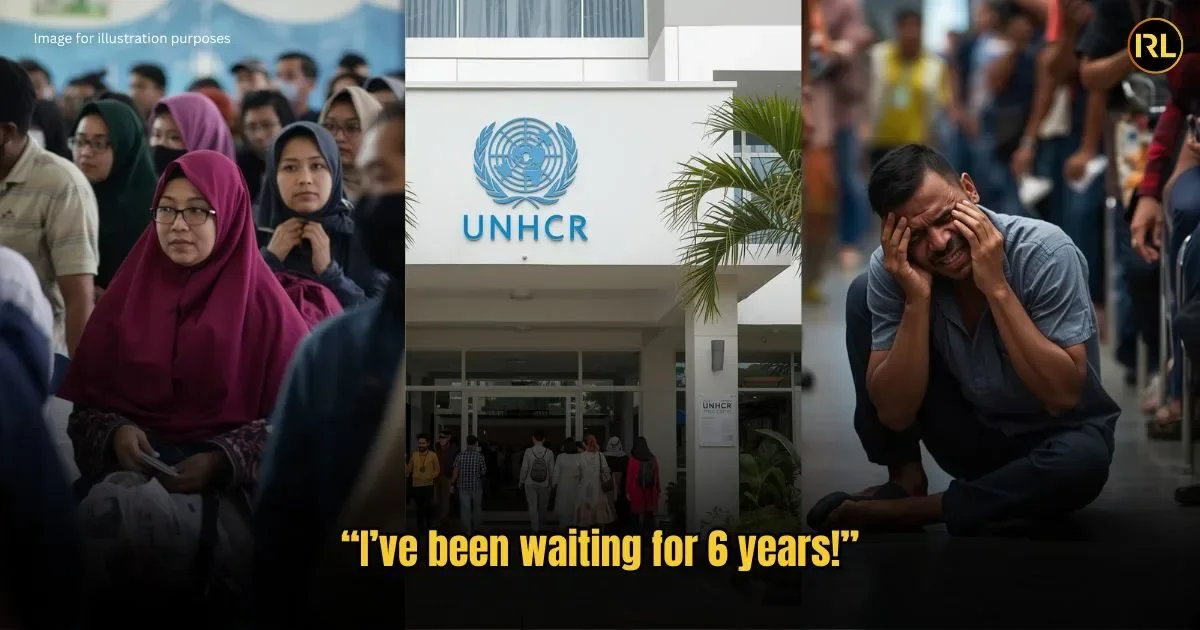
This story is about life in a UNHCR waiting room, where pain, hope, and patience collide. Every person carries a story that time refuses to hurry.
When Waiting Becomes Survival: Inside a UNHCR Centre
Amal Haj Sleman
People think waiting is empty. They imagine silence, boredom, a clock ticking. My waiting didn’t look like that. Mine smelled like instant coffee and damp documents and sounded like a hundred languages trying to explain the same heartbreak. I didn’t choose to become part of this place. One day I walked into UNHCR with my life story and the room swallowed me like it had been expecting me.
Lesson One: Don’t jump when your number isn’t called
The first thing I learned was that time works differently here. It stretches, then snaps, then folds in on itself. You can come in at 7 in the morning and somehow find yourself still sitting there in the afternoon, holding the same pen, the same breath. The guards change shifts. The sunlight moves. The speakers glitch.
And you sit, trying not to imagine the version of yourself who used to have a future with a shape.
Behind every chair was a story. Some people kept theirs quiet. Others spilled theirs all over the floor, loud and frantic, hoping volume alone could speed up their process. The rest of us sat in the middle trying to look patient even when patience felt like another form of breaking.
The first person I really noticed was a woman sitting 2 chairs away from me. She wore the same expression every newcomer had before they learned how long waiting could stretch, alert, hopeful, trying to keep her shoulders straight. Her scarf was slipping off one side of her head and she kept fixing it with small nervous fingers, like she was scared of drawing attention and scared of being ignored at the same time.
She held her folder the way some people hold their breath. Tight. Close to her chest. The corners were soft from being opened and closed too many times. I recognised that look. It was the look of someone who rehearsed her answers the night before, someone who didn’t sleep well, someone who knows that one wrong sentence can change the shape of her life.
When the staff called a number, she jumped even though it wasn’t hers. Then she looked around embarrassed, as if anyone of us had energy left to judge her.
I remember thinking: she’ll learn the rhythm soon. We all do. Not because we want to but because the room teaches you without asking for your permission.
The family time forgot how to hold
A few seats across sat a man who never really got to sit. He had 2 small kids with him, both restless in that way children get when they’ve run out of patience before the day even begins. One was climbing onto his lap, the other sliding off his shoulder. Every few minutes he’d whisper something soft to calm them, something in a language I didn’t know but recognised by the tone: stay close, stay quiet, I know you’re tired.
His wife sat beside them, rubbing her forehead like she was trying to press her thoughts back into place. Their folder was thick, overflowing with photocopies and stamped pages, the kind of paperwork that grows heavier the longer your life is on hold.
The man kept apologising to everyone around him, even when his kids did nothing wrong. He apologised when their toy fell, when they laughed, when they bumped someone’s knee. Maybe he believed if he stayed polite enough, small enough, he could make the room see them as a family worth speeding up.
But every now and then he’d look toward the counter with this sharp, disappointed hope, the kind parents get when they’re trying to be strong for their kids but their strength is running out. I saw him press his thumb into his palm very hard. A private gesture. A way to hold himself together.
What I felt watching them wasn’t a pity. It was recognition. They were living the same waiting I was, just louder, messier, harder to hide.
What six years of waiting can do to a man
He arrived like an earthquake. His footsteps were so heavy you could feel the floor shake a little with each one, and every head in the room lifted at once, the way people react when a storm breaks too close. He wasn’t just loud this time, he was shaking with a kind of anger that comes from grief pressed down too long. You could see it in the way he held his jaw, tight like he was afraid his whole face would fall apart if he let it loosen.
He didn’t walk to the counter; he charged.
“I’ve been waiting for 6 years!,” he said in broken English, voice cracking between rage and something softer he refused to let out. “You said you would call. You said you would follow up. You said you didn’t forget my file.”
The staff kept their eyes down. Not because it was a rule, but because they didn’t know what to do with someone already breaking. They’d seen too many scenes like this and learned to look away, hoping it would burn out on its own.
But his fire was already burning.
“You don’t understand,” he said, pounding the counter with the flat of his hand. “My son is sick. My wife is losing hope. I can’t keep telling them lies just to make them sleep at night.”
A guard approached from the wall, fast, controlled, like he’d done this too many times. He asked the man to step back, but the man only got louder.
“I’m begging you! If you lost my file, tell me. If you can’t help us, tell me. Don’t make me die of waiting.”
When the guard touched his arm, he collapsed in a way no one expected. Not violently, he just folded. His knees hit the floor. His voice cracked open and all the anger spilled out as raw crying, the kind that echoes in your chest even when you don’t know the person.
The guard had to drag him forcibly toward the exit because he couldn’t stand. The whole room watched, silent, guilty for watching. His crying wasn’t soft. It was years of fear and pain pouring out all at once.
A few minutes later, maybe 5, maybe 15, who knows, he came back. His face was wet. His shoulders small. The guard led him in quietly this time.
And then something strange happened.
The same staff member he was shouting at motioned toward an empty chair near the wall.
“You can sit here,” she said. “We will call you soon.”
He didn’t thank her. He didn’t apologise. He just nodded once, like a man accepting a punishment he’d already lived through.
He sat down.
Still trembling.
Still broken open.
But calmer, like the storm inside him had lost its violence and was now only heavy rain.
And the room, the whole room, felt different after that.
It was like he broke open for all of us, said the things we swallowed, cried the tears we kept hiding.
His pain wasn’t separate anymore. It spread into the air, heavy and familiar and somehow it made the waiting feel like something we weren’t carrying alone.
The people who were supposed to help
The volunteers, officers and security guards at UNHCR were human. I remind myself of that sometimes. They weren’t born with hard faces or flat voices. The system shaped them, the same way it shaped us, just from the other side of the counter.
Some days, they were kind. Kind in the tired, practical way people are when they’re drowning in work but still trying to hold on to their humanity. A soft look. A rushed smile. A paper pushed through faster than usual. A whispered “come back after half an hour, I’ll check again.” Small proof that someone inside the inhumane system still cared.
But other days, their cruelty came out in quiet ways. Not shouting. Not insults. Something smaller, sharper. Though I’ve seen that too.
A volunteer who wouldn’t look you in the eye.
An officer who slid your file away like it was something dirty.
A guard who spoke to you like you were a problem, not a person.
A staff member who sighed before you even opened your mouth, as if your existence was one task too many.
Sometimes they acted like pain was contagious and they needed to keep a distance or they would catch it themselves.
I saw one woman cry in the bathroom once, a volunteer, not a refugee. She was leaning over the sink, wiping her face quickly, like she didn’t want anyone to know she had a heart left. When she came out, her voice was flat again, the mask pulled tight.
The cruelty wasn’t personal. It was worse than personal, it was routine. The kind that grows in places where too many tragic stories pile up, where desperation becomes background noise, where pain is processed like paperwork.
I once saw a man try to peek into the office to ask if his number had been skipped. He didn’t even finish his sentence before a guard pushed him back so hard he stumbled. The whole room watched, but no one spoke. Not because we didn’t care, but because we knew how quickly the wrong tone could cost us something we couldn’t afford to lose.
So on the days I had to go to the centre, I made myself small. Small enough to pass unnoticed, small enough to avoid the sharp voices and the sudden scolding that could land on you for no reason except someone else’s bad day.
Every cold tone, every dismissive gesture, we felt all of it. Waiting makes your skin thin. Everything touches you cut deeper than it should
And still, they were the only ones who could move our cases forward. The only bridge between our cursed past and whatever future might still be left.
So we swallowed the cruelty. We thanked them anyway.
Because in those rooms, you learn quickly: the people with power are allowed to be tired. The people without it cannot.
Not an ending
When my number was finally called, I stood up slowly, like the chair had been holding more of me than I realised. The room buzzed behind me, papers rustling, kids crying, the man who broke still wiping his face. I walked toward the room where my interview was held with my file pressed to my chest, the same way everyone does.
I didn’t know if today would change anything.
The hallway felt colder than the waiting room, quieter too, the kind of quiet that makes you hear your own heartbeat. I stopped in front of the interview door and waited for the door to be opened. Someone inside was finishing their story, maybe for the third or fourth time. That’s how it worked here, you told your life over and over until someone decided which version mattered.
I kept my eyes on the floor tiles. They were worn in the middle, smooth from too many feet pacing the same line of hope and fear. I wondered how many people had stood exactly where I was standing, holding exactly what I was holding, the thin proof that their life had happened.
When the door finally opened, I took a breath.
Not a brave one.
Just a necessary one.
I pushed the door open and stepped inside.
My case wasn’t solved that day. Nothing big happened. No life changing news. No miracle. But when I stepped outside, the air felt different, lighter maybe, or just cleaner after the heaviness inside. I took a deep breath and let it settle in my chest.
It was enough to keep going for one more day.
Sometimes that’s all waiting gives you.
Write in. Tell your story. Get paid.
Share your story on our Facebook page and you may become a contributor for In Real Life Malaysia.
I Made Sure My Ex-husband Lost Everything After He Cheated On Me With A 21 Year Old Influencer
More from Real People
“I only wanted to help him stand up again” Elderly Man’s Kind Gesture Ends in Debt and Gambling Fallout
A well-intentioned act of kindness quickly turned into a heartbreaking lesson about the dangers of debt and online gambling after …
“I Was In Tears” shares Activist who Rescued Elderly Man From Run-down House
This story is about a Malaysian activist who rescued an elderly man allegedly locked inside a dilapidated home in Kelantan …

‘A RM100 fee cost a company 5 years of revenue’ shares M’sian
This story is about a Malaysian who learned that bureaucracy can be defeated simply by not arguing with it.A billing …