






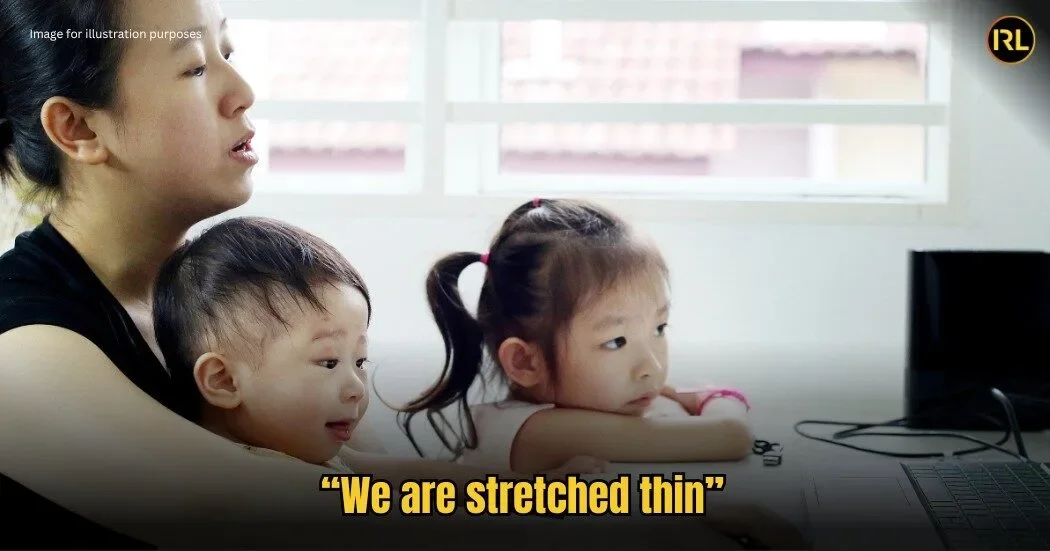
This story is about the silent struggles that those Malaysians in the middle class, the M40, face on a daily basis.
It’s 7:00 AM in suburban Selangor. A mother quietly packs nasi lemak into tupperwares while her child gets dressed for school. The school shoes are worn out, stitched and taped more than once. Her partner has already left for work — a job that pays just enough to stay afloat, but never enough to move forward. The car is parked today. The family calculated that it would be cheaper to let the children take the bus than to top up the petrol for another week.
On the surface, this household seems “okay.” There’s food on the table, the bills are being paid, and the children are in school. They even manage the occasional meal out or a small gift for birthdays. They appear “middle class.”
But the reality tells a different story — one of invisible compromises, quiet anxieties, and a constant fear of slipping through the cracks. The truth is, the Malaysian middle class is under strain, and no one seems to be talking about it.
Living in the In-Between
Malaysia’s middle class has long been seen as the engine of economic growth — educated, employed, and aspirational. In the past, being in the middle bracket came with certain markers: a car, a home loan, access to healthcare, and perhaps a modest vacation once a year.
But in today’s economy, these markers no longer guarantee comfort. Many now find themselves caught between rising living costs and stagnant wages. It’s a life lived in between — not poor enough to receive financial aid, not rich enough to absorb price hikes.
Groceries have become more expensive, but salaries haven’t changed. School-related costs — uniforms, tuition, extracurricular activities — continue to climb. For many families, it’s now normal to juggle multiple jobs, or pick up freelance work at night just to keep up with monthly commitments.
Some have moved back in with extended family to save on rent. Others are taking out personal loans to cover emergencies or relying on credit cards with interest rates they’ll never fully clear.
A Safety Net with Holes
Government aid typically targets the B40 (bottom 40%) group. Meanwhile, the T20 (top 20%) has the means to maintain their standard of living. But those in the M40 — the middle 40% — often fall through the cracks.
There is little to no financial assistance, yet every price increase affects them deeply. They pay full price for fuel, full price for education, full price for healthcare. And they do so quietly, because society tells them they should be grateful.
But what if being middle class no longer means financial security?
What if it now means being one unexpected expense away from disaster?
A burst pipe. A hospital visit. A retrenchment notice. These aren’t rare occurrences — they’re very real threats that many are constantly preparing for, despite already having nothing left to cut.
The Emotional Cost
The weight isn’t just financial. It’s emotional.
There is a deep, persistent pressure to appear okay — to show up to work looking polished, to say “we’re managing” even when anxiety keeps you up at night. There’s the guilt of not being able to give children more, the shame of asking for help, the constant comparison to those who seem to be doing better.
Mental health struggles are common but often hidden. Therapy is too expensive, and rest feels like a luxury no one can afford. Burnout becomes the norm. Smiles become masks.
And while social media bombards the middle class with stories of financial success, self-made entrepreneurs, and passive income streams, it only reinforces the fear that if you’re struggling, it’s somehow your fault.
But it’s not about mismanagement. It’s about systems that no longer work the way they used to.
Dignity in the Details
In the middle class, sacrifice hides in plain sight.
It’s in the couple who downsizes to one car. The student who chooses a local university not out of preference, but practicality. The parent who skips their own medical check-up to save for a child’s braces.
It’s in the decision to fix a broken washing machine for the third time instead of buying a new one. It’s in the delayed dreams, the quiet recalculations, and the silent pride of “making it work” — even when it’s barely working.
And maybe that’s the hardest part: the constant effort to hold onto dignity while letting go of comfort.
What Needs to Change?
Acknowledgement is the first step. For too long, the middle class has been overlooked in national conversations. The focus is often on poverty alleviation or high-income growth, but rarely on the very group that forms the backbone of the country.
It’s time for policies that reflect actual living conditions, not outdated income brackets. Assistance must be scaled with sensitivity to urban vs rural costs, family size, and real inflation.
Financial literacy and savings campaigns won’t work if people simply don’t have enough to save. What’s needed is wage reform, affordable childcare, better access to healthcare, and safety nets that actually catch people when they fall.
Because the truth is: the middle class isn’t okay.
They are tired.
They are stretched.
And they are being left behind while still being asked to carry the nation forward.
The next time someone says, “We’re managing,” don’t assume everything’s fine.
Sometimes, “managing” means they’ve just mastered the art of struggling in silence.
Have a story to share?
Submit your story to ym.efillaerni@olleh and you may be featured on In Real Life Malaysia.
Read also: “I Thought I Had Made It In Life,” Shares M’sian Woman Who Regrets Buying a House – In Real Life
“I Thought I Had Made It In Life,” Shares M’sian Woman Who Regrets Buying a House
More from Economy
“Trump’s Tariffs Seem Insane, But There’s Logic Behind It,” Says M’sian News Commentator Lim Sian See
This thinkpiece analyses the impact of Trump's recent tariffs on the global economy, and how it will affect Malaysia's GDP …