






In 2023, Malaysia repealed Section 309, a colonial-era law that made suicide attempts a crime. The change marked a shift from punishment to mental health support. This story follows a Malaysian man who lived with depression in silence, too afraid to seek help.
Until 2023, surviving a s**cide attempt in Malaysia meant risking investigation and punishment under Section 309 of the Penal Code. You could be fined, even jailed, for trying to end your life.
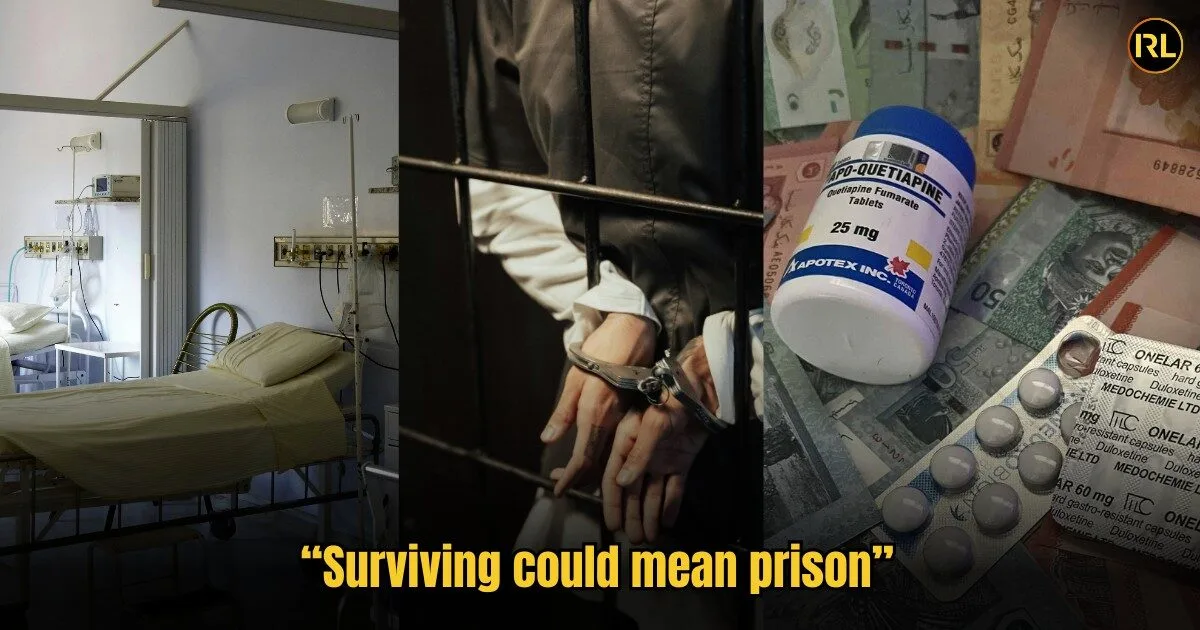
The only reason I didn’t swallow two handfuls of pills with a bottle of whiskey in 2015 was because I was scared. Not of dying, but of waking up in a hospital bed because the police might be waiting outside, not to help you, but to put you in handcuffs.
Fear kept many of us quiet. We learned to hide our pain, hoping the silence wouldn’t kill us before the law did.
Today it’s called Help. Last Year, it was a Crime
Section 309 made it illegal to try to take your own life. The idea was that the law would stop people from ending their lives. Clearly it failed. All it did was stop us from seeking help.
People hid their pain to avoid police reports. Survivors feared hospitalisation because it meant paperwork, statements, and questions from officers. Families feared humiliation more than tragedy. Companies never said it, but they would not hire the “mentally unfit.”
Now, things look different. You see posters with hotline numbers in clinics. Police are being trained as Crisis Intervention Officers (CIOs). But before all that, a uniform only meant fear.
Shame Came After Survival
If my attempt had failed, it wouldn’t just be me dealing with the consequences. My parents would’ve carried the humiliation: The gossip, the police report, the whispers at every Hari Raya, wedding and other funeral.
In some twisted way, dying would be “cleaner” than surviving. That’s the part no one talks about. How a mix of law, shame, and silence taught us to disappear inside ourselves.
The law might have changed, but the mindset it created hasn’t disappeared overnight. Families still whisper instead of talk. People still treat survivors and surviving as something to be embarrassed about.
Years of Pretending to be Fine
I lived through years of untreated depression because I was terrified of being labelled “crazy” or worse “criminal.”
I went to PPUM once, and at the registration counter for the psychiatric clinic, the nurse confirmed quietly if I was there for, “pasal sakit otak.” A medical practitioner whispered it like it was contagious. The lurking security guard, dressed in blue didn’t help my nerves. I turned, walked out and never went back.
I doomed myself to years of suffering in silence because private care was too expensive and public care felt depressingly unsafe.
At that time, therapy wasn’t normal. Awareness campaigns didn’t reach small towns or campuses. Most of us didn’t even know what options existed. So I learned to function while quietly breaking down. Survival meant staying alive, not getting better.
Now, they say CIOs are there to escort you to safety. But back then, I couldn’t imagine them as anything except enforcers.
When the Law Finally Changed
In 2023, Malaysia finally repealed Section 309 — a colonial-era law that punished s**cide attempts. Decriminalisation means survivors should now get medical attention first, not handcuffs and charges.
It’s a relief to have help without handcuffs. But the relief is bittersweet. I think about the years lost in silence, whiskey in one hand, handful of pills in the other. I feel anger and rage, for the people that succeeded and didn’t live to see this change.
Under the new Mental Health (Amendment) Act, Crisis Intervention Officers – police, firefighters, maritime officers, civil defence, and welfare workers – are the first responders when someone is in danger. They can enter homes to reach people in crisis and take them to hospital for medical and/or psychiatric assessment.
On paper, it’s progress. In reality, it’s an attempt to legislate empathy. Authority means nothing when these front line officers need training to talk to someone on the edge, convince them to step away from the edge of the ledge without making it worse.
What Real Progress Looks Like
Fear kept me alive once. But only compassion, openness, and real access to mental healthcare will help those in need go back to living, instead of merely surviving.
If officers are the first contact, they need proper crisis de-escalation skills and sensitivity to stigma. Training can’t just be a one-off seminar. It must be an ongoing process. Is certification required? What does training even look like?
The government says 145 hospitals can handle crisis cases. Are these hospitals properly funded, staffed and equipped? Otherwise, survivors will be “stabilised,” handed a prescription, and discharged for the cycle to repeat itself.
Workplaces matter too. If someone gets pulled into a hospital after a CIO call, will HR protect their privacy? Or will there be whispers that they “broke down” or have “issues?” Without workplace protection, stigma will keep quietly winning, no matter what the law says.
Can We Change How We Care?
Repealing Section 309 was a huge step forward because no one needs to fear handcuffs when they need someone to see them as human and a helping hand. But this is only the beginning. We need trained responders, funded hospitals, affordable therapy, and a society that listens without judgement.
Back then, I feared waking up to handcuffs. Now, I just hope anyone who wakes up gets a hand to hold instead.
Mental Health Resources in Malaysia
- Befrienders KL (24/7 Emotional Support): Call 03-7627 2929
- MMHA (Malaysian Mental Health Association): Counselling, therapy, support groups
- Relate Malaysia: Affordable online therapy and education
- Klinik Kesihatan (MOH): Government-run clinics with mental health services
- MIASA: Peer support, advocacy, events
- University Counselling Centres: Free for students (check with your uni)
- Talian HEAL (MOH Mental Health Hotline): Dial 15555
Got feelings you don’t know how to handle? You’re not alone—and you’re not broken. Start by talking to someone. That’s already a win.
Write in. Tell your story. Get paid.
Share your story on our Facebook page and you may become a contributor for In Real Life Malaysia.
I Made Sure My Ex-husband Lost Everything After He Cheated On Me With A 21 Year Old Influencer
You might also like


More from Real Mental Health
‘Everyone Saw A Successful Student While I Was Crumbling,’ Shares 22 Year Old Student
This is a story of a 22 year old woman who shared her story as a Straight A’s student as …

5 Harmful Mental Health Myths Malaysians Still Believe
Let’s break down five of the most common myths Malaysians still believe, and why it’s time to let them go.

“We Aim to Democratise Mental Healthcare,” shares Dr. Johan Founder of Chengal Clinic
In this interview, IRL speaks with Dr. Johan Ariff Juhari, psychiatrist and founder of Chengal Centre for Mental Health.