






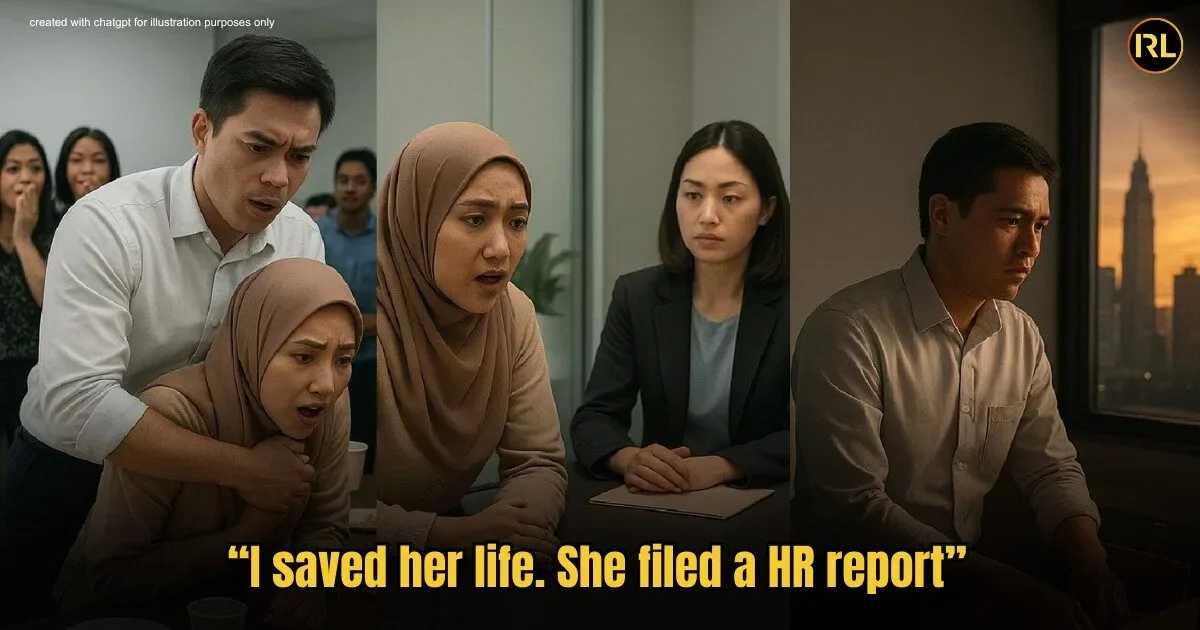
This story is about a man who tried to save a colleague’s life, but instead found himself at the center of an HR investigation.
When an ordinary Friday lunch went wrong, a small office of twelve found itself arguing over what it means to “do the right thing.”
It started during the monthly pizza lunch. Laughter, paper plates, easy conversation. Then someone coughed—a quick, sharp sound that didn’t stop. Within seconds, everyone saw that the woman at the end of the table was choking.
One of her colleagues, a man who had recently completed certified first-aid training, jumped up and tried to help. He did what he had been taught: wrapped his arms around her from behind and pressed upward beneath the ribcage. The piece of pizza crust dislodged, she gasped, and the room exhaled in relief.
Someone brought her water. She sat for a minute, nodded that she was all right, then quietly left for the restroom. The mood of the lunch never recovered; the group drifted back to their desks.
The Complaint
The following Tuesday, HR called both of them in for an emergency meeting: A complaint had been filed. The report described “improper physical contact” and said the rescuer’s body had been too close.
The woman, who is Muslim, said she had felt deeply uncomfortable and believed the contact crossed professional boundaries.
HR witnesses confirmed they had seen the incident and that it matched standard first-aid procedure. Still, company policy required an investigation. The man was suspended with pay for one week while statements were taken from everyone who had been in the room.
Seven coworkers supported his account. After reviewing video from a corner camera that showed the moment in question, HR cleared him of misconduct.
The Fallout
Cleared or not, the experience left marks. When he returned, colleagues noticed a change. Once talkative and sociable, he now kept to himself. If a woman entered the pantry while he was there alone, he stepped out. If the lift doors opened and a female coworker was inside, he waited for the next one.
He told a friend, “I did everything right, and still got treated like a criminal.”
Some colleagues sympathised; others felt uneasy. “It’s like we lost the version of him who used to make everyone laugh,” one said. “Now he won’t even look at us.”
The Apology
A week later, the woman tried to apologise. She told HR she hadn’t meant to ruin his reputation, that she had panicked and felt invaded in that moment, but later realised it had been a misunderstanding. HR arranged a meeting with both present.
He listened without responding. When she finished, he said only, “Your apology doesn’t erase the investigation,” and left the room.
He turned to the HR representative, “Apology not accepted.” HR noted that both parties had been heard.
The woman received a written reminder about filing sensitive complaints responsibly. He received advice to attend a workplace-wellness session to help rebuild trust. Neither was satisfied.
The Distance Grows
The rift spread beyond the two of them. Team lunches stopped. Group chats went silent. The next pizza Friday was cancelled.
He began avoiding company social events altogether, stating that he had “other plans.” When pushed he finally snapped that he wasn’t attending because he didn’t want to “make anyone choose sides.”
To him, the decision was about self-protection. To others, it sounded like resentment.
Transfer and Aftermath
A month later he requested a transfer to another branch. HR approved it, noting “irreconcilable interpersonal tension.” The move shortened his commute but did little to quiet the rumours.
Even in the new office, he sensed people whisper.
“They’ve all heard half the story,” he told a colleague. “I’m the guy who got accused.”
The woman remained at the original office. Friends said she still avoided talking about the incident. “She feels guilty,” one coworker said. “She didn’t expect him to be punished that harshly, but she also can’t forget how that moment felt.”
Nobody Agreed on Anything
The damage lingers: Month’s later debate still continues. Some say HR did the right thing by taking every complaint seriously. Others call it a failure of common sense that punished a good deed.
A few point out that cultural and gender boundaries can clash with standard medical training. Others argue that empathy should have gone both ways as trauma doesn’t always fit procedural logic.
The rescuer insists he learned his lesson. When asked privately whether he would act again if someone collapsed, he said, “I’ll call 999. I’m not touching a colleague again.”
A lifesaving act fractures a team this badly, maybe the bigger problem isn’t who was right or wrong—but how quickly we stop talking once the investigation ends. Or maybe, never start an investigation at all.
Write in. Tell your story. Get paid.
Share your story on our Facebook page and you may become a contributor for In Real Life Malaysia.
I Made Sure My Ex-husband Lost Everything After He Cheated On Me With A 21 Year Old Influencer
More from Office Drama
“I Deliver My Work. Why Do You Need My Instagram?” Employee Questions Company’s Request for Her Socials
This story is about an employee who tried to protect their privacy, only to be treated like a troublemaker for …
‘She didn’t even close the door!’ Shares M’sian Faces Office Toilet Chaos
This story is about a Malaysian woman whose picture-perfect corporate office turned into a nightmare when she discovered her new …

‘A Work Trip to the US Turned Into Babysitting Duty,’ Shares M’sian Forced to Share Room with Coworker
This story is about a Malaysian office worker who was sent to the US for work training, but faced unprofessional …