





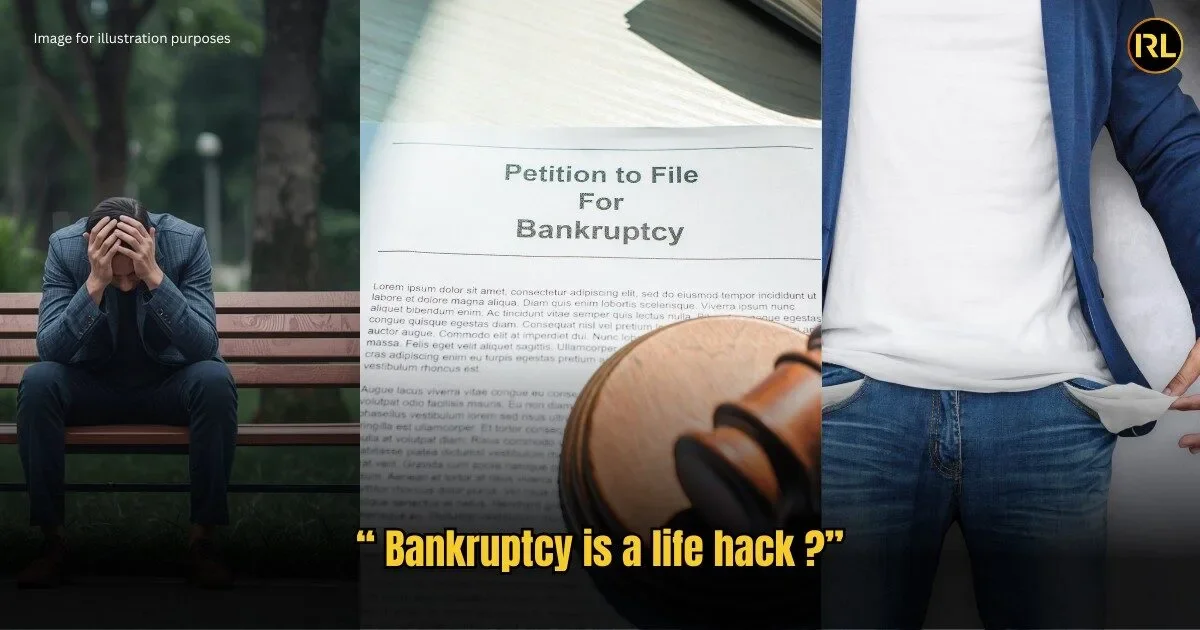
This is the story of a Malaysian guy who declared himself bankrupt and somehow, it ended up saving his life.
When he walks into an interview room, he keeps his hands steady. He speaks clearly, smiles when he needs to. But somewhere throughout the whole process, the question always lands like a punch in the face:
“Are you currently an undischarged bankrupt?”
For one 28-year-old Malaysian man who agreed to speak anonymously, that question is now the quiet defining factor of his life. Nothing about his education, experience or skills defines him as much as this one legal status that seems to follow him wherever he goes. He’s a bankrupt person.
His bankruptcy case didn’t come from a failed business or reckless spending. Life simply became too much for him to handle.
This is the reality for a growing number of young Malaysians who are quietly opting to self-declare bankruptcy purely out of sheer exhaustion with a system where wages, living costs and debt simply don’t match anymore.
The Breaking Point
His story begins like most Malaysians in their twenties:
A stable job with a salary that was “just okay, not great either.” A car loan he needed for work. A personal loan he took to help his parents settle medical bills. Then came the moment everyone dreads during a restructuring exercise. The all-mighty, glorified word: ‘retrenchement’ (because, let’s be honest, some companies can be brutally ruthless).
“I tried to pay. I juggled the payments one by one. But every month, the late charges ate me alive. As we all know, whenever we paid the loans, it was never the principal that went down, it was always the penalties.” he sighed.
By 28, he owed more than RM120,000 across personal loans, a car loan and accumulated interest.
Rather walking away from it, he walked straight into the Malaysian Department of Insolvency and filed a Debtor’s Petition which is the legal process of voluntarily declaring oneself bankrupt.
And he joined a rising demographic.
According to Malaysian Insolvency data:
- self-declared bankruptcies nearly doubled from 2023 to 2024
- most bankrupts fall between ages 25–44
- the biggest contributors are personal loans, car loans and credit cards
He is just one face in a crowd that’s getting bigger every year.
What Bankruptcy Actually Looks Like in Real Life
He didn’t wake up the next morning magically debt-free.
Bankruptcy was never a reset button.
It felt more like being placed under financial probation.
The first thing he noticed was the silence from his bank apps. Most of his accounts were frozen almost immediately. In the end, he was allowed to keep only one salary account. Even that wasn’t fully his. Every ringgit that went in was visible, monitored, and subject to deductions ordered by the Director General of Insolvency (DGI). Nothing moved without oversight anymore.
Life became paperwork-heavy after that. Every six months, without fail, he had to submit a Statement of Affairs, a detailed breakdown of everything he earned and everything he spent. Rent. Food. Transport. Side income. Miss a deadline, and the consequences weren’t just administrative. They were legal.
A portion of his income was no longer negotiable either. Under Malaysia’s Second Chance framework, about 10% of what he earned was automatically channelled into the bankruptcy estate. It didn’t matter how tight the month was. That money was gone before he could plan around it.
Even movement became a privilege. If he wanted to leave the country for work, for family, even for a short trip he needed written permission. Spontaneity disappeared. Borders, like his finances, were no longer fully open to him.
And then there was work.
Entire career paths quietly closed overnight. Anything involving finance, company directorships, legal authority, or professional certifications was now off-limits. He could still be capable. Still be qualified. But the law didn’t care about capability. The label came first.
“It’s like carrying an invisible stamp,” he says softly.
“Even if I don’t tell anyone, the system knows.”
From the outside, nothing about him screamed bankrupt. But inside the system, every step he took was tagged, tracked, and constrained — a constant reminder that while the debt had stopped growing, the consequences were still very much alive.
The Psychological Tax
Bankruptcy is usually imagined as a scandal which is either dramatic, shameful or the ultimate failure or all of them altogether. But for him, it was a relief.
“The first night I slept properly in months,” he says. “At least I wasn’t drowning anymore.”
Still, the stigma lingers, creeping into every part of his life. “It’s not just debt,” he says quietly. “It’s the feeling that you failed at being an adult.”
The Job Hunt: Where the Real Struggle Begins
Here’s the part people don’t talk about: bankruptcy follows you into the workplace.
Some companies explicitly refuse to hire bankrupt individuals, especially in roles involving money, sensitive data or representation. Also, a bankrupt can’t become a company director, which means you can’t manage your own business or even a company you used to run.
He has been rejected multiple times after the background check stage.
“It’s not written in the email, but I know. The moment they ask for CTOS, I already expect silence.”
Eventually, he landed a job but not in his field and not at a salary level he used to earn. Many bankrupt youths end up doing simple gigs. Just enough to make it by the end of the month.
They survive but they stop progressing.
“I lost three years of career growth overnight.”
Why Young Malaysians Are Turning to Bankruptcy as a Strategy
Bankruptcy used to be a last resort.
Today, it’s becoming a coping mechanism for a generation that is financially illiterate like him.
Some youths even see bankruptcy as a “controlled burn” i.e. destroy the financial structure now so you can rebuild cleanly later.
The DG of Insolvency has expressed concern that some individuals may be using bankruptcy strategically, knowing that the Second Chance Policy allows a relatively short discharge period if you cooperate.
For struggling Malaysians, though, it’s not a strategy. It’s a literal survival. If you don’t do this, you’ll die slowly.
Rebuilding from Rock Bottom
Three months into bankruptcy, his life runs on precision.
Every week, he survives on a RM50 budget. He plans his meals carefully, counts every purchase, and knows exactly how long each ringgit needs to last. There are no credit cards anymore. No safety nets. If the money isn’t there, the answer is simply no.
Reporting to the Department of Insolvency has become routine. Income, expenses, side earnings everything must be accounted for. Nothing is casual. Nothing is left vague. His financial life now exists in spreadsheets and forms, measured and reviewed at regular intervals.
To make ends meet, he takes on small side gigs whenever he can. Cash only. Quiet work that doesn’t leave a digital trail. Not because he’s hiding, but because survival leaves little room for flexibility.
Despite all of this, he doesn’t believe bankruptcy ruined his life.
To him, it merely paused it.
The pressure to keep up, to juggle impossible payments, to pretend he was fine — that’s what nearly broke him. Bankruptcy, in its own harsh way, gave him space to breathe again.
“I didn’t choose bankruptcy because I gave up on life,” he says.
“I chose it because I wanted to live.”
What His Story Says About Malaysia Today
His experience is not some sensational TV3 drama, it’s disturbingly normal. Which is sad.
A whole demographic of Malaysians is now living in this limbo of restricted accounts, limited jobs, heavy stigma and years of slow financial rehabilitation.
But beneath their stories lies a harder truth: Bankruptcy is no longer an exceptional failure. It’s becoming an ordinary survival tool.
You can call it irresponsible, or reckless, or poorly planned.
But behind every bankruptcy file number is a human being who simply got cornered by the math of modern Malaysia.
And honestly, if we think about what that says about our financial literacy… it hurts a little too much, doesn’t it?
Write in. Tell your story. Get paid.
Share your story on our Facebook page and you may become a contributor for In Real Life Malaysia.
I Made Sure My Ex-husband Lost Everything After He Cheated On Me With A 21 Year Old Influencer
More from Business
“I Lost RM 20,000 of my Grandparents Savings in A Failed Business,” Shares 21 Year Old Student
This is a story of a 21 year old student that decided to open a vending machine business and loaned …