




The lawyer called
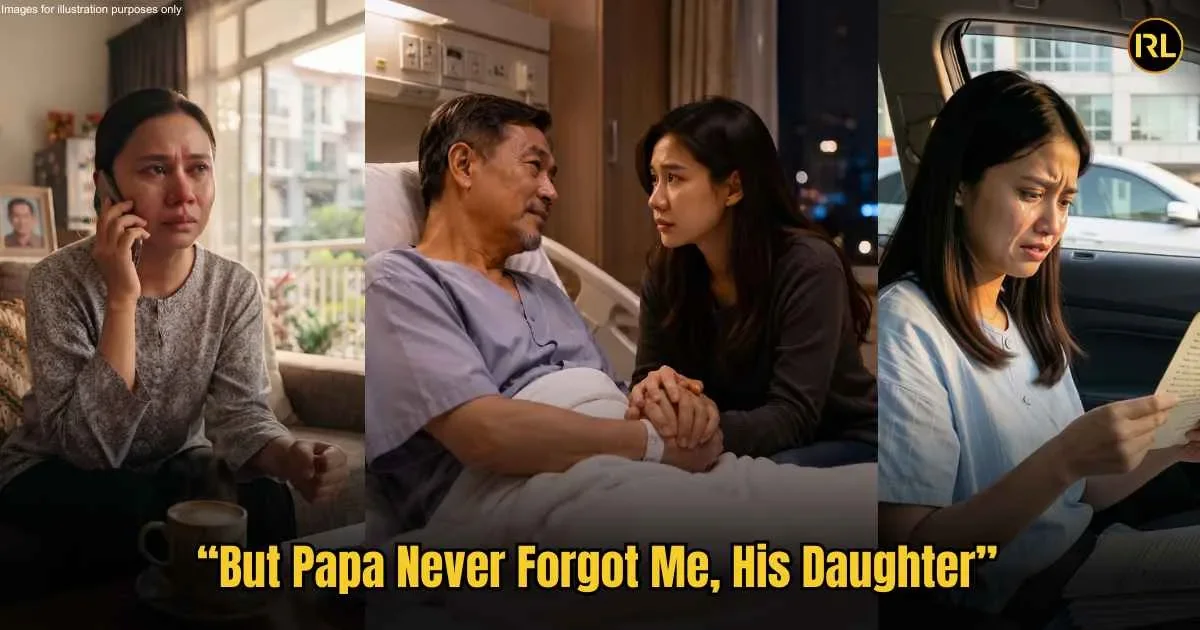
Papa died six months ago. Living with the grief had become a quiet part of my daily routine. Then his lawyer called me. “I am handling your father’s estate. Can we meet?” I thought it was just for paperwork.
Before everything became complicated
I was an only child. Mama died in a car accident when I was 13, and Papa became both parents to me. He wasn’t perfect. He was an ordinary Malaysian father doing his best, and I never doubted him or his love.
We had late-night mamak meals and movie nights. He helped me with homework, took me to tuition and taught me to drive. His last gift to me was the Myvi he bought me when I graduated from university.
Papa found happiness again
After Mama died, Papa was alone for a long time. Then he started dating again. He met someone during my second year at university. Eventually, he told me he wanted to get married again. I wasn’t excited, but I wasn’t angry either. I remembered how lonely Papa used to be. “If she makes him happy, then I’ll try,” I told myself.
My stepmother was polite, formal and distant. She was never cruel, but there was always a hard boundary between us. It was always “your father” and never “our family.” She also had a son, my 14-year-old stepbrother, six years younger than me. We coexisted, but never developed a real relationship.
Years passed, and we became experts at looking like a happy family over meals, birthdays, Hari Raya and holidays. Those moments were believable to outsiders.
Inside the house, we were disconnected people respectfully sharing the same space.
Papa noticed. He tried to bring us together with family outings to Sunway Lagoon, holidays to Cameron Highlands and Genting, and stories at the dinner table because he wanted everyone to laugh together. I think he believed that time together would forge us in to a family.
Then Papa started forgetting things. His phone. His keys. His wallet. Then appointments. He started having headaches and blurry vision. “Getting older,” he’d joke. We’d smile. Then he had a seizure.
Our last conversation
He was admitted to hospital and underwent a series of tests. The diagnosis was glioblastoma, a type of brain tumour. Surgery was scheduled. When he was at his worst, we pulled together. We stayed optimistic and talked about recovery. None of us wanted to discuss what could go wrong.
The night before his surgery at Pantai Hospital Bangsar, I was scared. Papa noticed. He squeezed my hand. “I love you. Don’t worry so much. Everything will work out.” I held his hand and hugged him.
This was the last time my Papa would look at me and know his daughter.
The first time I lost him
The surgery lasted seven and a half hours. I spent the entire time in the waiting room. When the doctors told us it had gone well, everyone was relieved. Papa woke up and looked around the room. He recognised his second wife. He recognised his stepson.
Then he looked at me. He frowned. “…Who is she?”
At first, nobody panicked. The doctors explained that anaesthesia, swelling and the trauma of brain surgery could affect memory and cognition. We were told he needed time to recover. So we waited.
His memories gradually returned. He remembered his childhood, his friends and university days, his business and travels, his favourite recipes and his neighbours. He remembered almost everything. Except me.
Every time I visited, Papa would ask who I was. Every time, I introduced myself. Again. And again. And again. The doctors continued to investigate, but they could not explain why he could recognise other familiar people but not me.
There was no simple answer. And there was nothing I could do to make him remember.
Eventually, I became the stranger
At first, my stepmother was gentle. “Don’t stay too long.” Then: “He’s tired. Go. Let him rest.” Then: “You’re upsetting him.” Finally: “You should leave.” I didn’t know whether she was trying to protect him, protect herself or simply didn’t know what else to do.
What I did know was that Papa no longer knew who I was. I started visiting my father alone. I would sit beside Papa and talk to him anyway. I told him about my work and things that happened at home. Sometimes I talked about memories he had once shared with me.
He listened politely. But I was still a stranger. Eventually, during one visit, Papa became uncomfortable and asked the stranger to leave him alone. My stepmother was called, then security. There was no shouting. No fight. I left and never visited my father again.
The second time I lost him
Papa never truly recovered from the surgery. There were complications. Six months later, cancer took his life. I was at his funeral, but I remember very little of it. I remember standing metres from my father’s coffin and feeling empty. I had already said goodbye to him months earlier.
The man who died was my father. But the father I knew had disappeared the day he looked at me and asked: “…Who is she?”
I had lost him once when cancer took away his memory of me. Then I lost him again when cancer took his life. And the worst part was knowing that he died believing I was a stranger.
Living without answers
Six months after the funeral, I met his lawyer expecting paperwork. Instead, he slid a sealed envelope across the desk. I recognised Papa’s handwriting immediately. Shaky, but definitely his. There were several folders beside it.
“Your father’s instructions were clear,” the lawyer told me. “Read the letter. Then we’ll discuss the rest.” The letter was dated a few days before his surgery.
Papa had written it while he still knew exactly who I was. He had written about the risks he had been warned about, including death and the possibility that surgery or the illness could affect his memory and ability to recognise the people around him.
He had prepared for the worst. He had also made arrangements, created a trust and left instructions with his lawyer so I would be protected financially if he was no longer able to look after me.
The letter said:
“If you’re reading this letter, things didn’t work out the way either of us hoped. The last thing I told you was, ‘I love you. Don’t worry so much. Everything will work out.’ There is a trust fund only for you, to make sure you are protected and provided for because I might not be there to do it myself.
You never once asked me to choose between you and the life I was trying to rebuild. I know it was hard for you and I know you tried. Thank you for accepting my second marriage and letting me find some happiness again.
You have never needed to compete for my love. You were my daughter the day you were born. You will be my daughter every day after I’m gone.”
He still keeps me safe
The lawyer gave me his card and told me he would follow up about the trust and the rest of my father’s estate. I left his office and sat in the Myvi Papa had bought me when I graduated from university. And I cried.
Because, for the first time since his surgery, I had an answer.
Papa had known there was a possibility that the cancer or the surgery could take parts of him away. He couldn’t control what could happen, but he prepared, making sure I was protected, provided for.
And he left me proof so I would know that he never chose to forget me. The last time I saw my father, he looked at me and saw a stranger. But before his surgery, he had sat down and written to the daughter he knew he might one day be unable to recognise.
Cancer took away his memory of me. It never changed who I was to him. So he left me the words instead.
I love you, Papa.
Submit your story to ym.efillaerni@olleh and you may be featured on In Real Life Malaysia.
Read also: ‘I gave up my family to pursue my dreams’ Shares 34 YO M’sian woman – In Real Life
https://inreallife.my/i-gave-up-my-family-to-pursue-my-dreams-shares-34-yo-msian-woman/
‘I gave up my family to pursue my dreams’ Shares 34 YO M’sian woman
More from Family Relationships
“It Was Actually Healing For Everyone” M’sian Woman Finds Forgiveness In Dad’s Dementia
Leong Jui Chuan, a travel agent based in Shah Alam, was not looking for healing when her father's dementia began. …
“She Left While Her Daughter Was Asleep” M’sian Family Reunites Helper With Daughter After 3 Years
Three years ago, Itri left her home in Indonesia before her daughter woke up. She could not bring herself to say …
“My parents got scammed, and I’m the one paying the price” shares 28 yr old malaysian woman
This is a story of a woman, who is a single child who found out that her parents lost their …