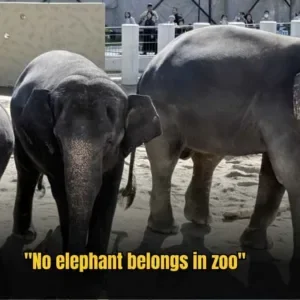




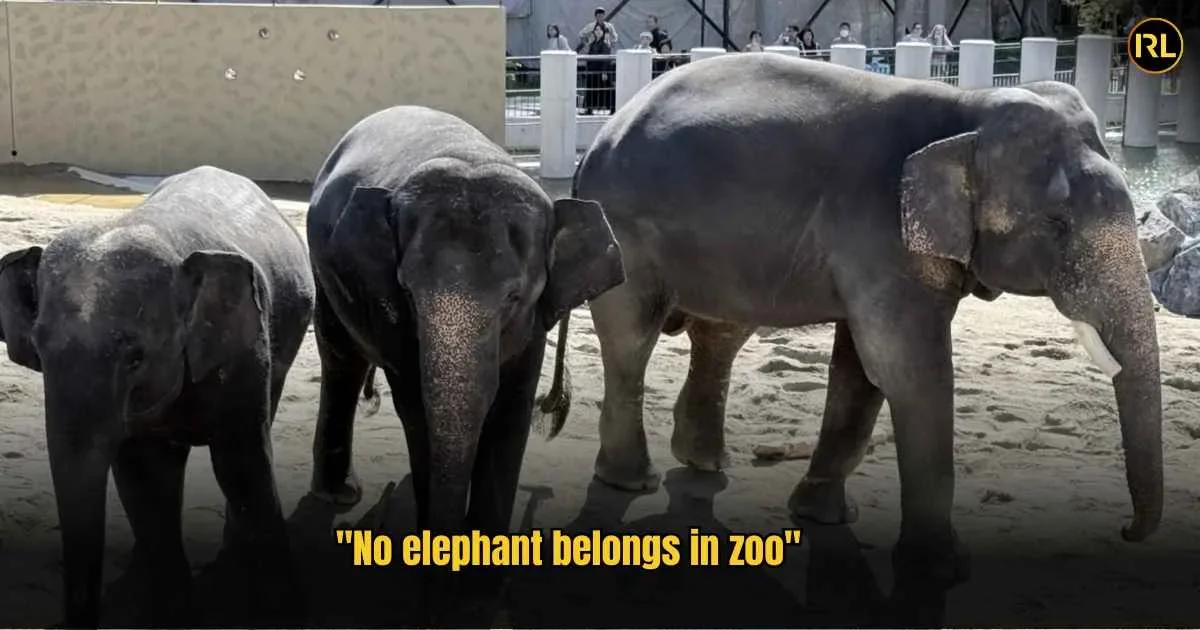
A TikTok user named Cik Moji was watching a livestream of Tennoji Zoo in Osaka when she began to cry. On screen, two of Malaysia’s elephants, Dara and Amoi, were pressed up against a wall in a narrow strip of shade, the only cover available to them in an enclosure that, for much of the day, sat exposed under the sun. Visitors in the background were using umbrellas.
“Kenapa buat macam ini kat gajah kami?” she asked through tears. Why are you doing this to our elephants?
The video spread quickly in Malaysia, and the animal welfare advocates who spoke to SAYS said they were not surprised, because this was exactly what they had been warning about for months.
Inside the enclosure
Norashikin Che Omar, an advisor to the Malaysian Animal Welfare Society (Shelter Ihsan), told SAYS that a mechanical roof had been built inside the enclosure, but said it was positioned too high and there was only one.
“They really have to find a cool, shaded place. That is all they can get,” she said.
Animal activist Datin Shereen Yunos, who has shared welfare assessment reports by elephant specialist Dr William Keith Lindsay with authorities, described the canopy as offering no meaningful protection.
“There is a canopy, but it’s really very small. And there’s hardly any protection from the sun. So it’s basically just a parasol,” she told SAYS.
Norashikin Che Omar, an advisor to the Malaysian Animal Welfare Society (Shelter Ihsan), told SAYS that a mechanical roof had been built inside the enclosure, but said it was positioned too high and there was only one. “They really have to find a cool, shaded place. That is all they can get,” she said.
Animal activist Datin Shereen Yunos, who has shared welfare assessment reports by elephant specialist Dr William Keith Lindsay with authorities, described the canopy as offering no meaningful protection. “There is a canopy, but it’s really very small. And there’s hardly any protection from the sun. So it’s basically just a parasol,” she told SAYS.
Both activists pointed out that elephants need more than shade, including water deep enough to float in so their joints get relief from carrying their weight, and mud baths for skin protection. Norashikin described a past video where Kelat placed a foot into the pool at the enclosure and immediately pulled it back out, as though the water temperature had startled him. Shereen said the pool was too small and too shallow for the elephants to properly immerse themselves.
“Whereas in the rivers, they actually float, so their legs dangle, and they are given some sort of relief from carrying all that heavy weight,” she said.
According to a Malaysiakini report from June, Lindsay assessed the enclosure at approximately 1,612 square metres. While this meets Japanese association minimum requirements, it is considerably smaller than the 20,000 square metres recommended in Britain for up to four elephants. His report criticised the artificial environment, the lack of vegetation, shade and mud, and recommended that the elephants be returned to Malaysia.
Kelat’s weight loss and the musth explanation
The welfare concerns have been compounded by a separate controversy over Kelat, the male elephant, who has lost approximately 100kg. The Taiping Municipal Council (MPT) acknowledged the weight loss in a statement last week and attributed it to musth, a natural hormonal phase in adult male elephants, which it said Kelat had been experiencing since 18 August. The council said he remained active, cooperated during training, and responded well to keepers.
Norashikin said she was not fully satisfied with this explanation. “How many times has he been isolated? How many times is he going to go through that phase? Regarding losing up to 100kg, I could accept it if it was during that phase. But if it happens too frequently, I think something is not right. You have to come with facts. Show us the facts about why he became like that,” she said.
The RM53 million question
The three elephants, Dara, Amoi and Kelat, were transferred from Zoo Taiping to Tennoji Zoo in March. Since then, the circumstances of the transfer itself have come under scrutiny. The Malaysian Anti-Corruption Commission (MACC) announced in June that it was investigating alleged irregularities, including claims that payments linked to the transfer had not been channelled to the government and whether elements of corruption, abuse of power or misappropriation had occurred. Wildlife advocacy group Hidup had raised allegations from a whistleblower that the transactions amounted to an estimated RM53 million.
In July, MACC said it had found no evidence of suspicious fund transfers involving a former minister or companies associated with him. Investigations involving four other individuals were still ongoing. SAYS asked for further updates and Hidup’s lawyer Rajesh Nagarajan said: “No update at all. MACC is just keeping very silent.”
What advocates are asking for
MPT has said its representatives, zoo officials and PERHILITAN officers visited Osaka in October 2022 to assess the facilities before the transfer and that all required permits and approvals were obtained. Shereen and Norashikin told SAYS they have not seen any official assessment establishing the enclosure is safe for the elephants in their current circumstances.
Shereen said she had forwarded Lindsay’s welfare findings to the government and sought a meeting with its leadership, but had received no confirmed time or date. NRES has said it was not a signatory to the agreements governing the elephants’ placement, with the arrangement sitting between Tennoji Zoo and MPT. The federal government has urged zoo management to discuss mechanisms for returning the elephants if their placement no longer meets conservation and welfare principles.
For Shereen, the core question is not whether the enclosure technically meets Japanese minimum requirements. It is whether Dara, Amoi and Kelat are well, and on that, she said, an independent expert needs to give an answer that neither the zoo nor the council has provided.
“The assessment for wellbeing should be done by an independent, verified expert,” she said. “No elephant belongs in a zoo. To keep them imprisoned in a concrete enclosure such as Tennoji’s, devoid of any natural surroundings as their habitat, is pure cruelty in my opinion.”
SAYS has reached out to Tennoji Zoo, MPT, PERHILITAN, NRES and MACC for comment but had not received a response at the time of publication.
Submit your story to ym.efillaerni@olleh and you may be featured on In Real Life Malaysia.
Read also: ‘I gave up my family to pursue my dreams’ Shares 34 YO M’sian woman – In Real Life
https://inreallife.my/i-gave-up-my-family-to-pursue-my-dreams-shares-34-yo-msian-woman/
‘I gave up my family to pursue my dreams’ Shares 34 YO M’sian woman
More from Community

“I Am Uncomfortable With Dogs” Celebrity Preacher’s Call To Ban Pet Dogs Divides Malaysia
A dog attack that left a young girl named Nur Haira in an induced coma after being set upon by …
“Not an Official Decision,” Fahmi Says on the 200K worker, Bangladeshi minister’s claim
On August 30, a Bangladeshi junior minister announced that Malaysia would recruit 200,000 workers from Bangladesh over six months, starting …

“Send Them Where?” asks PM Anwar Ibrahim over Malaysia’s Rohingya dilemma
On July 27, more than a hundred Rohingya refugees arrived in Kuala Lumpur, having left a settlement in Kampung Kuala …