






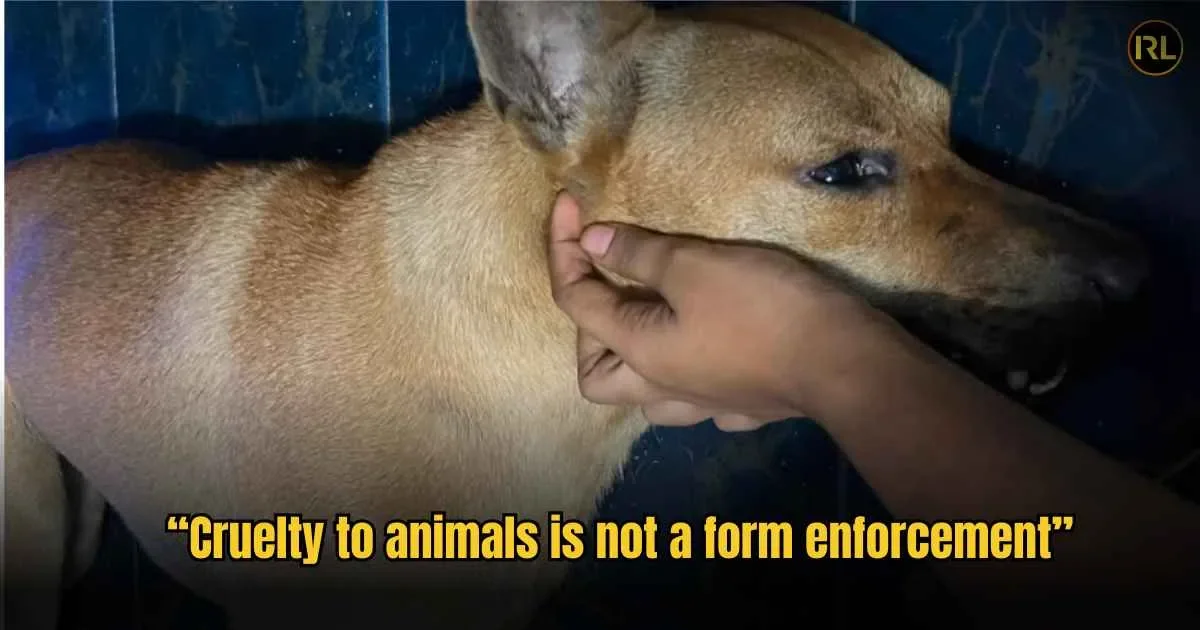
On the night of July 29, a pet dog named Rocky was killed in Taman Teluk Gedung Indah, Port Klang. His owner, Roghinidevi, says she returned home to find Rocky restrained by two men with what she described as a transparent cable containing steel wire, not a standard dog-catching loop, one that later required officers to cut open with a cutter.
She says she and her daughter tried to free him but were stopped by members of the public, and that she was struck on the hand with a stick while trying to intervene. By the time council officers arrived, she said, Rocky had already died.
The alleged trigger was an earlier, separate incident claiming that a dog had bitten a child weeks before. The owner disputes that Rocky was the dog involved. That claim has not been independently verified.
A video of the incident circulated widely online, showing the owner crying and pleading for the rope to be removed while others in the crowd shouted back at her to let go. Whatever disputes exist about how the operation was run, nothing in any account changes the basic fact of a pet dog dying slowly, in front of the person who loved him, while he was restrained and unable to escape.
Two accounts of who was there, and what they did
MBDK, the Klang city council, says the operation that night ran from 8:30pm to midnight, prompted by formal resident complaints about stray dog safety in the area. Twelve dogs were captured; Rocky was the only one that died. The council says the woman turned aggressive while trying to cut the restraint, threatening to harm herself if the dog was not released, and that the resulting commotion made it difficult for officers to safely intervene.
A 24-year-old man, Muhammad Shah Hizam, has since come forward as the person accused in the case. He denies intending to harm or kill Rocky, saying he was taking part in the MBDK operation as a residents’ representative rather than acting on his own.
His lawyer says the restraint used belonged to MBDK itself, not something he brought. That claim, if accurate, does not resolve the central question: if council-issued equipment was used to restrain and ultimately kill a dog under a formal operation, the responsibility question points toward how that operation was designed and supervised, not just who was holding the rope.
The rights group’s position
Persatuan Haiwan Terbiar Malaysia (SAFM), an animal welfare group, called for police and internal council investigations. Its president, Kalaivanan Ravichandran, said the absence of a dog license does not give anyone the right to beat, strangle, drag, or kill an animal.
He also said two MBDK officers were present at the scene and asked the council to explain why they did not stop what was happening, and whether the group of men acted with the council’s knowledge or instruction. “There are lawful enforcement procedures in place to address these issues. Cruelty to animals is not a form of enforcement,” he told FMT.
How the public split
The story went viral through a Threads post from Rocky’s owner, and reaction has divided sharply since. Some commenters condemned the killing outright as cruelty. Others defended the action, pointing to months of complaints in the area about aggressive stray dogs and arguing residents had grown frustrated with the council’s response, or lack of one.
Where the case stands now
Two parallel investigations were opened. Police confirmed an investigation under Section 428 of the Penal Code, mischief by killing an animal, which carries up to three years’ imprisonment, a fine, or both. Separately, the Selangor Veterinary Services Department recorded statements from a suspect and witnesses under the Animal Welfare Act, which carries a heavier penalty of RM20,000 to RM100,000 in fines, three years in prison, or both.
As of August 5, police submitted the full investigation paper to the Deputy Public Prosecutor’s office and are awaiting instructions. No charges have been filed. Roghinidevi, represented by lawyer Choo Dee Wei, is weighing legal action of her own, pending the outcome of both investigations.
A political voice joins
Charles Santiago, a former MP for Klang, published an opinion piece calling for those involved to be identified and held accountable. He later criticised MBDK directly, calling it callous for the council to frame the owner as “aggressive” in its defense.
Separately, lawyer Vivek Sukumaran said the incident should be viewed as a warning sign of a growing culture of mob violence.
Vivek, who chairs the Bar Council’s criminal law committee, said footage of the incident circulating online should concern all Malaysians. A crowd willing to beat a frightened animal to death showed that people had developed a tendency to respond to grievances through collective violence, he said, adding that such behaviour could extend beyond animals.
“We have already seen it directed at people. Suspected thieves have been beaten by crowds before police could arrive. Crowds have gathered outside police stations to issue ultimatums to investigators. A society that normalises mob action against animals is training the mob for everything else,” he said in a statement issued in his personal capacity.
Selangor royalty also weighed in. The Tengku Permaisuri of Selangor, Norashikin, called on the federal government to review and toughen penalties under the Animal Welfare Act 2015.
A problem with no clear rulebook
Rocky’s death is not the first time a stray dog culling operation in Malaysia has ended in public outrage, and animal welfare groups say that’s the point. Complaints about how councils handle stray dog populations, when to trap, when to euthanise, who is authorised to act, have surfaced on and off for over a decade without a consistent national standard.
Different councils have followed different practices, and enforcement has often fallen to whichever combination of officers, volunteers, or residents happened to be on hand that day, which is exactly the ambiguity both Rocky’s owner and MBDK pointed to in their conflicting accounts of who was actually in charge that night.
MBDK maintains it followed procedure, saying officers used approved capture methods, a loop pole and net, in line with SOPs set by the Housing and Local Government Ministry (KPKT). But the council’s own mayor also described the resource strain behind the operation: fewer than 20 enforcement personnel for the entire council area, around 50 stray dog complaints a month, and no private contractor willing to take on the work, leaving council staff to run capture operations themselves and, by the council’s own admission, ask residents to help.
This isn’t the first time an SOP defense has followed a stray animal death, either. A dog named Kopi was shot and killed during a council operation in Besut in 2024, and that council also cited compliance with its own SOP and local by-laws.
On August 5, protesters gathered outside the Klang council building, calling on Putrajaya to adopt a trap-neuter-manage approach instead of continuing to catch and kill strays. It’s a method animal welfare groups have pushed for years, and one that avoids the kind of ad hoc, under-resourced operation that MBDK itself admitted to, telling reporters the council was short-staffed and had asked residents to help catch strays.
Until there’s a clear, enforced standard for how these operations are supposed to run, cases like Rocky’s will keep happening.
Submit your story to ym.efillaerni@olleh and you may be featured on In Real Life Malaysia.
Read also: ‘I gave up my family to pursue my dreams’ Shares 34 YO M’sian woman – In Real Life
‘I gave up my family to pursue my dreams’ Shares 34 YO M’sian woman
More from Dogs

Rokcy’s Case Follow up: Owner Now Faces Animal Cruelty Charge
This piece is a follow-up to Rocky, the dog whose death on July 29 sparked nationwide outrage online. On August 20, …
“Left The Animal To Die” MBJB Contractor Kills Stray Dog In Johor Neighbourhood
A CCTV clip, roughly 20 seconds long, was all it took to set off a chain of official responses that …

“My mother got rid of the family dog,” shares M’sian woman who went no-contact with her mother
In this story, a mother's cruelty destroyed her relationship with her own daughter, and it began with the family dog.