





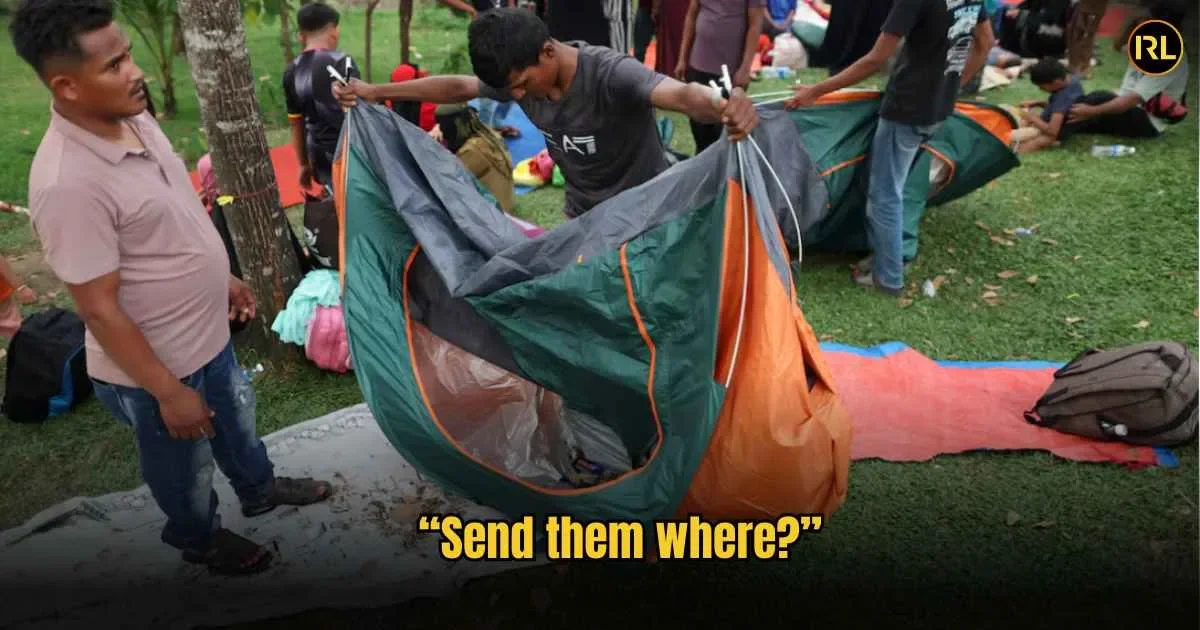
On July 27, more than a hundred Rohingya refugees arrived in Kuala Lumpur, having left a settlement in Kampung Kuala Muda, Penang, two days earlier. They had travelled overnight by bus, families with children among them, and gathered outside the office of the UN refugee agency on Jalan Bukit Petaling. Some set up tents on the spot, their children played nearby while police and armed forces personnel monitored the area.
The refugees who arrived in Kuala Lumpur said they had been forced out and intimidated into leaving according to Washington Centre. But Malaysian authorities told NST a different story: a month-long notice period, a departure coordinated jointly by the National Unity Department, the Penang state government, and the National Security Council. But the scene these refugees left behind tells its own story: motorcycles, fishing gear, and kids’ bicycles still leaning against the walls,
Prime Minister Anwar Ibrahim addressed the gathering in a social media post that evening. Malaysia is a sovereign country, he wrote, and every individual within it must follow its laws. Anyone without valid travel documents or permits would face legal action, including detention at an immigration depot. By that evening, police had loaded 113 people into four trucks and taken them into custody at Kuala Lumpur police headquarters. Among them were children who’d already spent one night sleeping on the pavement outside an aid office, now spending the next one in a police compound.
Every person detained that night was already registered with the UN refugee agency and held valid documentation.
When it ended, Kuala Lumpur Police Chief Datuk Fadil Marsus said all 113 had been moved in stages to Kuala Lumpur, Selangor and Penang to shelters chosen by NGOs and the UN agency based on where each person had relatives or acquaintances, a small mercy after a rough week.
A decade of living there
Seberang Perai Utara police told BFM News the relocation stemmed from economic and territorial tensions, noting the Kampung Kuala Muda settlement had grown from 12 to 33 rented houses over the past decade. The Star spoke to two named residents who defended the decision to push the community out. However, their accounts didn’t capture what a decade actually meant for the families living there who built homes, created a life for their kids who’d never known another home since fleeing Myanmar and probably think of Kuala Muda, not some village across the sea, as where they’re from. None of that mattered on the day they were made to leave.
A country that shelters people it doesn’t recognise
Malaysia has never signed the 1951 Refugee Convention. In practice this means the roughly 126,000 Rohingya registered with the UN agency in the country hold documents that Malaysian law does not formally acknowledge. On paper, they are undocumented migrants who happen to also be UN-recognised refugees. That contradiction has stood for years, unresolved and mostly ignored. This month it surfaced.
Earlier in July, before the Penang eviction, the government had already asked the UN agency to pause registering new refugees while it builds its own system, a registration programme called Dokumen Pendaftaran Pelarian, intended to let Malaysia manage refugee data independently rather than rely on the UN agency’s records. The new system raises concerns among human rights organizations.
Then, a day after the detentions, foreign minister Mohamad Hasan went further. He said Malaysia should reconsider allowing the UN agency to operate in the country at all unless it agreed to screen applicants jointly with local authorities.
He described the current process, in which someone can apply online from Myanmar and collect a refugee card on arrival, as lacking a proper standard operating procedure. The UN agency responded that it remained committed to working with Malaysia.
This is not a new impulse. Malaysian officials have called for tighter control over UNHCR card issuance before, in 2017 and again in 2022, each time citing concern about the country being overburdened. What is different this time is the timing, arriving days before a state election, and the scale of public hostility building underneath it.
The hostility didn’t start with the eviction
Rights groups trace a sharp rise in anti-Rohingya sentiment online back to May, when a petition calling for the community’s removal from Malaysia gathered close to half a million signatures before it was taken down. Researchers say the campaign that followed fed directly into harassment, raids on Rohingya-linked businesses, and school closures.
Malaysia’s own Human Rights Commission, Suhakam, weighed in directly. In a statement on June 3, it condemned what it called a dangerous trend of dehumanisation in the rhetoric circulating against Rohingya refugees and urged Malaysians to reject the misinformation and inflammatory language driving it.
Reuters reported via The Japan Times that at least nine community-run schools serving Rohingya children have shut down nationwide in recent months. These schools exist because Rohingya children are generally barred from Malaysia’s public education system, so the informal learning centres are often the only schooling available to them.
Nur, a 12-year-old Rohingya refugee who stopped attending class after being threatened on her way to school, told Reuters: “If I don’t go to school, I won’t be able to learn anything.”
A Rohingya community activist, speaking about children in the same position, said the harassment goes beyond a single bad day. It leaves lasting psychological harm.
A deputy foreign minister told parliament that many Malaysians have grown weary of the burden of managing the Rohingya population, language that mirrors the framing officials have used for years to justify tighter controls. Meanwhile a home minister described the government’s approach as an attempt to balance national security against humanitarian obligations, a framing that leaves both goals somewhat undefined.
FMT reported last month that these community schools exist precisely because stateless Rohingya children cannot enrol in national schools without documentation, and are run by NGOs or the community itself rather than under the Ministry of Education. The same report noted that a Kedah-based Malay student coalition had raised separate concerns about the curriculum content taught at these unregistered schools, since they operate outside the Ministry’s official syllabus.
Rights groups say the response missed the point
Amnesty International Malaysia condemned the detentions this week, arguing that a humanitarian situation was treated as a law enforcement matter. Its spokesperson put it plainly: the response turned what was fundamentally a humanitarian solution into an enforcement issue.
A Human Rights Watch representative made a related point to Reuters. Life for Rohingya refugees in Malaysia, they said, means living under constant threat of arrest and raids, in a climate of fear that has worsened alongside the online hostility. Their message to the government was direct: focus on protecting the people who fled Penang, instead of terrifying them further by detaining them.
An announcement timed to an election
On July 30, Anwar announced that Myanmar had agreed to take back 5,000 Rohingya currently in Malaysia, framing it at a campaign rally ahead of the Negeri Sembilan state election as the product of sustained diplomacy between the two countries, and a real attempt to give a stranded population somewhere to finally call home again. Rights groups have pointed out that conditions in Rakhine State haven’t changed enough yet to make return safe, a concern that will need answering before anyone gets on a plane.
Refugee policy announcements timed close to Malaysian elections aren’t new. Ahead of the 2022 general election, the government of then-PM Ismail Sabri launched a new refugee tracking system and floated closing UNHCR’s offices in the country.
Where things stand now
Home Minister Saifuddin Nasution Ismail confirmed Malaysia has started screening refugees for the planned return of 5,000 people to Myanmar. But Myanmar’s own foreign ministry pushed back days later, saying the plan only covers verified Myanmar nationals held in Malaysian detention centres, not Rohingya specifically. Myanmar still won’t recognise the Rohingya as one of its official ethnic groups, so a plan built on “good relations between the two countries” is already running into the same denial that’s kept the Rohingya stateless for decades.
By August 5, Malaysia had walked the certainty back too. Government spokesman Fahmi Fadzil said the country won’t send anyone home if their life would be at risk, and that the foreign and home ministries are still reviewing a plan the prime minister had already announced at a campaign rally. Rights groups have called this a rushed diplomatic win, announced before the safety questions were actually answered.
Refugees waiting in Malaysia for a resettlement or repatriation to actually happen aren’t just waiting. Given the right to work, they could be contributing to the country in the meantime. A 2019 study by the Institute for Democracy and Economic Affairs found that letting refugees work legally could add over RM3 billion to Malaysia’s annual GDP by 2024, create more than 4,000 jobs for Malaysians, and generate over RM50 million a year in tax revenue.
A joint ILO and UNHCR study found the same move could raise a country’s GDP by up to 0.5% over time. The Malaysian Employers Federation has already backed it, pointing to labour shortages in plantation, construction, manufacturing and services that refugees could help fill right now. Turning that exploration into policy could give Malaysia a durable answer to a problem that keeps resurfacing every few months.
Submit your story to ym.efillaerni@olleh and you may be featured on In Real Life Malaysia.
Read also: ‘I gave up my family to pursue my dreams’ Shares 34 YO M’sian woman – In Real Life
‘I gave up my family to pursue my dreams’ Shares 34 YO M’sian woman
More from Community
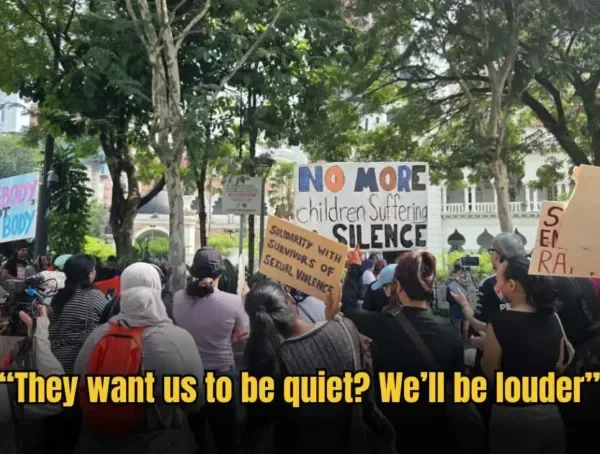
‘Dah Cukup’: Malaysians Artists Protest Sexual Harassment
Seniwati Solidarity, a coalition of Malaysian artists, gathered at Dataran Merdeka on October 11 to challenge sexual violence in the …

“Why Are You Doing This To Our Elephants?” Dara, Amoi And Kelat’s Condition At Osaka Zoo Explained
A TikTok user named Cik Moji was watching a livestream of Tennoji Zoo in Osaka when she began to cry. …

“I Am Uncomfortable With Dogs” Celebrity Preacher’s Call To Ban Pet Dogs Divides Malaysia
A dog attack that left a young girl named Nur Haira in an induced coma after being set upon by …